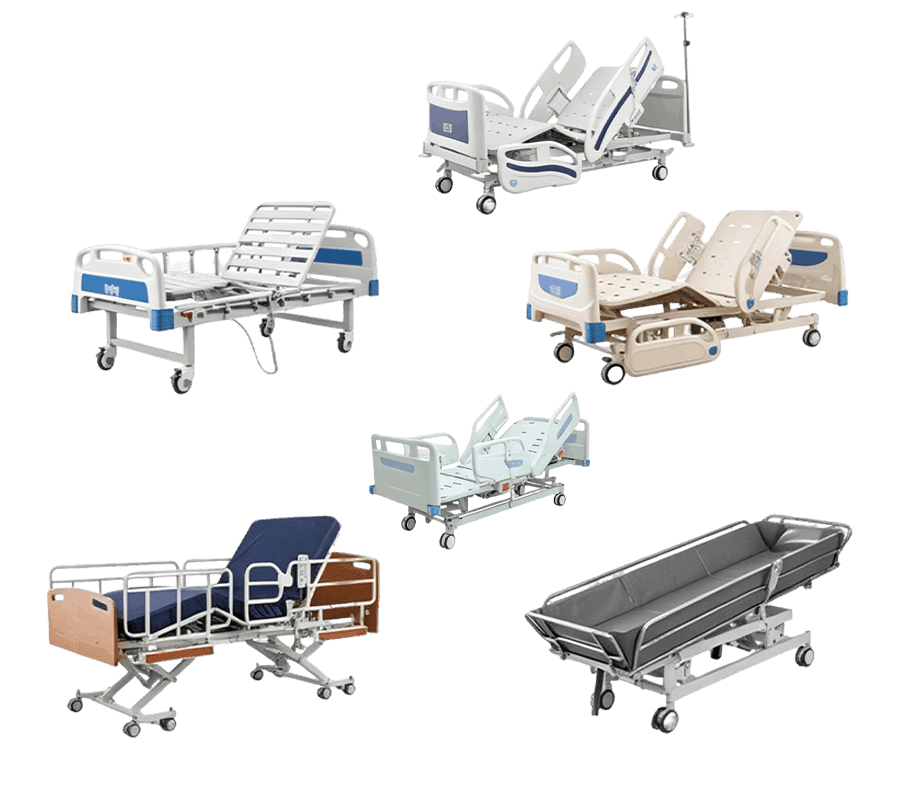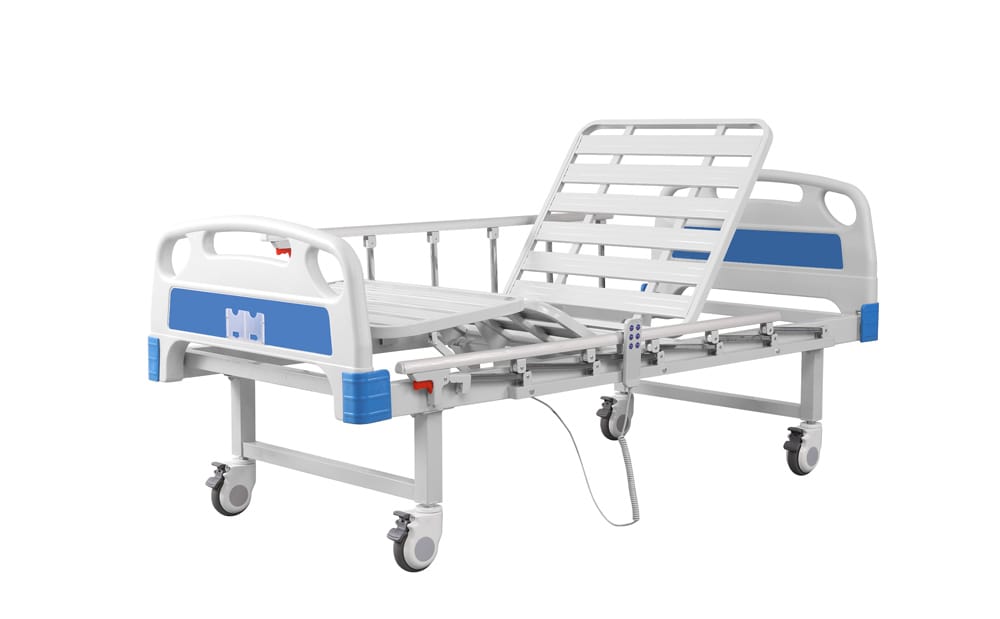
Hospital beds are commonly classified according to the number of adjustable functions they provide. Buyers may see two-function, three-function and five-function models that appear similar in product photographs but differ significantly in positioning capability, clinical application and price.
Choosing the model with the greatest number of functions is not always necessary. A five-function bed may be appropriate for an intensive care unit, while a simpler two-function bed may provide everything required in a general ward. Selecting an unnecessarily complex configuration can increase procurement and maintenance costs without creating meaningful benefits for caregivers or patients.
On the other hand, choosing a bed with too few adjustments may limit patient positioning, complicate nursing tasks and require the facility to replace the equipment earlier than expected.
This guide compares the main functions, applications and purchasing considerations of two-function, three-function and five-function hospital beds.
Table of Contents
What Does “Function” Mean on a Hospital Bed?
A hospital bed function generally refers to a major adjustable movement of the mattress platform or bed frame.
The most common movements include raising the patient’s upper body, bending the knee section, adjusting the complete bed height and tilting the entire mattress platform. These movements may be powered by electric motors or operated manually with cranks.
Manufacturers do not always count functions in exactly the same way. Buyers should therefore review the technical specification rather than relying only on the model name.
For example, one supplier may describe a bed with backrest, leg-rest and height adjustment as a three-function model. Another supplier may promote additional features, such as an auto-contour movement, without counting them as separate functions.
A quotation should clearly state which sections move, how they are operated and the adjustment range of each movement.
Quick Comparison of Hospital Bed Functions
The following table summarizes the typical differences between the three main configurations:
| Bed Type | Main Adjustments | Common Applications | Relative Cost |
|---|---|---|---|
| Two-function hospital bed | Backrest and leg-rest adjustment | General wards, clinics and basic patient care | Lower |
| Three-function hospital bed | Backrest, leg rest and complete bed-height adjustment | Hospitals, rehabilitation centers and nursing facilities | Medium |
| Five-function hospital bed | Backrest, leg rest, height, Trendelenburg and reverse Trendelenburg | ICUs, emergency departments and higher-level care | Higher |
The exact configuration can vary by manufacturer. Technical sheets should always be reviewed before comparing quotations.
What Is a Two-Function Hospital Bed?
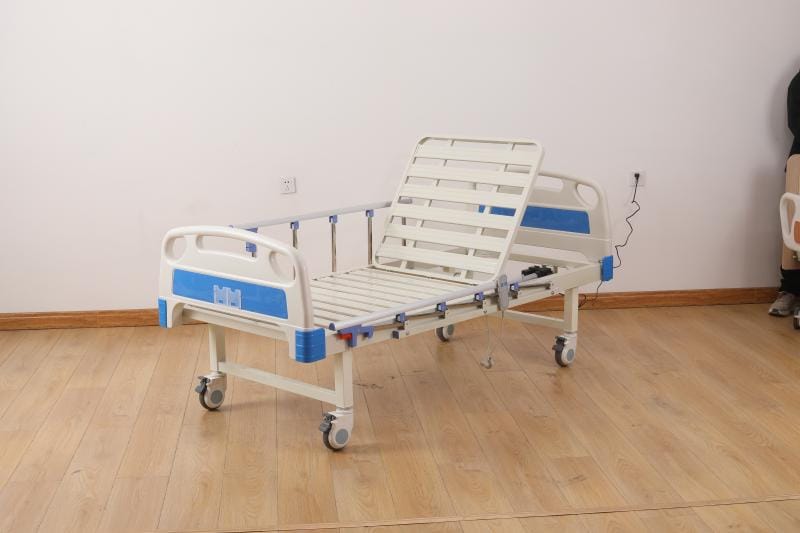
A two-function hospital bed normally allows the backrest and leg section to be adjusted independently.
Raising the backrest helps patients sit in a more upright position for eating, reading, breathing support and communication. It may also make certain nursing procedures easier.
Adjusting the leg section can support the knees and reduce the tendency of the patient to slide downward when the backrest is raised. The combination of these two movements creates a more comfortable seated or semi-seated position.
Two-function beds are commonly used in general hospital wards, community clinics, temporary medical facilities and care environments where advanced positioning is not routinely required.
They are available in both manual and electric configurations. A manual model uses crank handles, while an electric version allows the adjustments to be controlled with a handset.
Advantages of a Two-Function Hospital Bed
The main advantage of a two-function model is simplicity.
With fewer moving parts, the bed may be easier to operate and maintain. Manual models are particularly useful in facilities where electrical supply is unreliable or where maintenance resources are limited.
Two-function beds also tend to have a lower initial cost than models with height and tilt adjustments. This can make them suitable for large ward projects with strict budgets.
However, lower cost should not be confused with lower quality. The frame, side rails, casters and adjustment mechanism still need to meet the requirements of the intended clinical environment.
Limitations of a Two-Function Hospital Bed
The main limitation is that the complete bed height usually remains fixed.
A fixed-height bed may make some nursing tasks more difficult, particularly when caregivers need to perform wound care, reposition patients or assist with transfers. The ideal working height can vary depending on the caregiver and the procedure being performed.
A fixed bed may also make it more difficult to create a low position for fall-risk patients.
Two-function models are therefore most appropriate when backrest and leg positioning are the main requirements and frequent height adjustment is not necessary.
What Is a Three-Function Hospital Bed?
A three-function hospital bed normally provides backrest adjustment, leg-rest adjustment and complete bed-height adjustment.
The additional height function gives caregivers greater control over the working position. The bed can be raised during nursing procedures and lowered when a patient needs to enter or leave it.
This makes three-function models more flexible than fixed-height beds.
They are commonly used in general hospitals, rehabilitation centers, nursing facilities and private medical institutions. They may also be suitable for wards that handle patients with different mobility levels.
LOHO provides different electric hospital bed configurations for general wards and other healthcare applications.
Why Is Height Adjustment Important?
Bed-height adjustment can improve both patient access and caregiver ergonomics.
A lower position may help mobile patients place their feet on the floor more securely when standing. It may also reduce the distance to the floor for patients considered at risk of falling.
A higher position allows caregivers to work without bending excessively during routine nursing activities. This is particularly valuable in facilities where staff reposition patients, change dressings or perform examinations frequently.
The adjustment range should still be reviewed carefully. A product may be described as height-adjustable while offering a relatively limited minimum or maximum height.
Buyers should request the actual measurements rather than relying on general product descriptions.
Advantages of a Three-Function Hospital Bed
A three-function bed provides a practical balance between functionality and cost.
It covers the positioning requirements commonly needed in general healthcare environments without including the full tilt capability of an ICU bed.
The height adjustment can support safer transfers and more comfortable working positions. At the same time, the product remains less complex than many five-function models.
For hospitals and distributors that need a versatile product for several departments, a three-function electric hospital bed may be a suitable standard model.
Limitations of a Three-Function Hospital Bed
A typical three-function model does not provide Trendelenburg or reverse Trendelenburg positioning.
This means the complete mattress platform cannot normally be tilted with the patient’s head lower or higher than the feet.
These tilt positions may be required in intensive care, emergency treatment or certain clinical procedures. A three-function bed may therefore be insufficient for departments with advanced positioning requirements.
Some buyers also assume that every three-function bed includes the same motor system, height range and safety features. In practice, specifications differ between models and suppliers.
What Is a Five-Function Hospital Bed?
A five-function hospital bed generally provides backrest adjustment, leg-rest adjustment, complete bed-height adjustment, Trendelenburg positioning and reverse Trendelenburg positioning.
The additional tilt functions allow the entire mattress platform to move while remaining relatively flat.
In a Trendelenburg position, the patient’s head is lower than the feet. In reverse Trendelenburg, the head is positioned higher than the feet.
These adjustments provide greater flexibility for patient positioning and clinical care. Five-function beds are commonly associated with ICUs, emergency departments, recovery areas and other environments where patients require closer monitoring.
The bed may also include additional features such as nurse controls, emergency CPR release, battery backup, angle indicators and central locking casters. These features are not automatically included simply because the bed has five functions, so they must be confirmed separately.
Advantages of a Five-Function Hospital Bed
The main advantage is positioning flexibility.
Caregivers can adjust the upper body, legs, overall height and complete bed angle according to the patient’s condition and the required procedure.
Five-function beds may also provide a more ergonomic working environment for medical staff. The height and tilt adjustments can support different nursing and treatment positions without moving the patient to another surface.
For intensive-care projects, the five-function configuration is often used as the foundation for a more comprehensive bed system.

Limitations of a Five-Function Hospital Bed
A five-function bed has a higher initial cost than simpler models.
It also contains more electrical and mechanical components, which creates additional maintenance considerations. Motors, control boxes, handsets and tilt mechanisms must remain serviceable throughout the bed’s operating life.
Facilities that do not require tilt positioning may receive limited value from the extra functions.
A five-function model should therefore be selected because the clinical application requires it, not simply because it appears more advanced.
Two-Function vs Three-Function Hospital Beds
The main difference between two-function and three-function beds is complete bed-height adjustment.
Both configurations normally provide backrest and leg positioning. The three-function model adds the ability to raise or lower the entire mattress platform.
A two-function bed may be adequate for a basic ward where patients are relatively stable and caregivers do not need to change the working height frequently.
A three-function bed is more suitable when the facility wants greater flexibility for patient transfers, nursing procedures and caregiver comfort.
For many general hospitals and rehabilitation facilities, the three-function configuration provides a practical middle ground.
Three-Function vs Five-Function Hospital Beds
The main difference between three-function and five-function beds is the addition of Trendelenburg and reverse Trendelenburg positioning.
Both models generally provide backrest, leg-rest and bed-height adjustment. The five-function model can also tilt the complete mattress platform.
For general wards, the three-function model may be sufficient. For intensive care, emergency treatment and other departments that need more advanced positioning, the five-function configuration is usually more appropriate.
Buyers should not make the decision based only on the department name. The clinical team should confirm whether complete platform tilting is actually required.
Electric vs Manual Adjustment
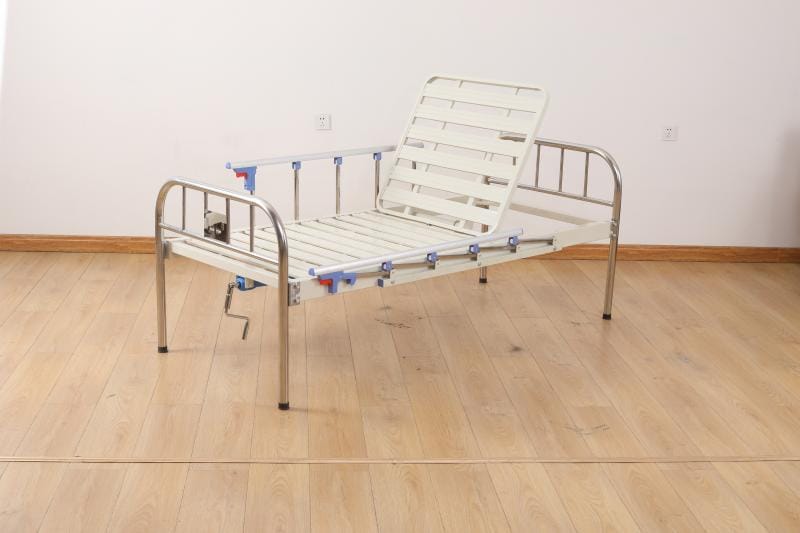
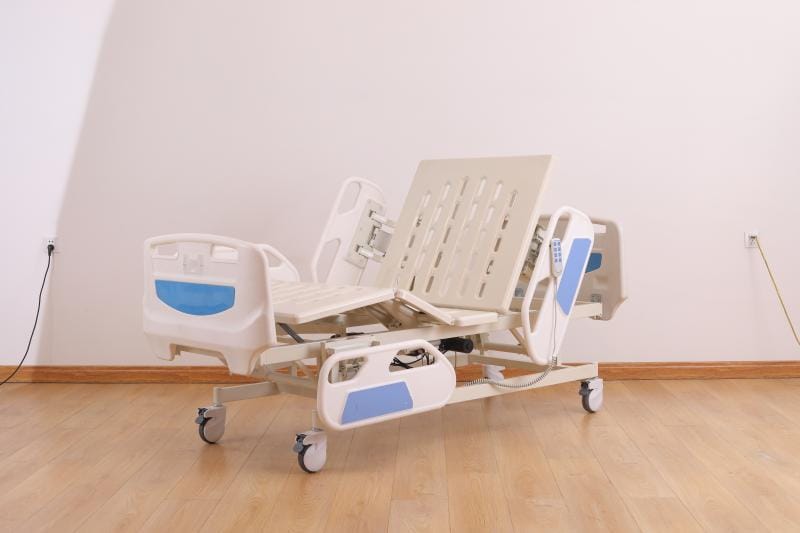
Two-function and three-function hospital beds may be available with either manual or electric adjustment.
Manual hospital beds use crank mechanisms. They have no dependence on motors, control boxes or electricity, making them relatively straightforward to maintain. However, every adjustment requires physical effort from a caregiver.
Electric beds use motors controlled by a handset or nurse-control panel. They allow positions to be changed more quickly and with less physical effort.
For facilities where patients require frequent repositioning, electric operation can improve convenience. It may also allow some patients to adjust their own position when permitted.
Five-function beds are usually electric because coordinating height and tilt adjustments manually would be less practical.
The choice between manual and electric operation should consider usage frequency, staffing, maintenance capability, electricity supply and project budget.
How to Choose the Right Configuration
The appropriate number of functions depends on the patient group, clinical procedures and frequency of adjustment.
A general ward with relatively mobile patients may need only backrest and leg positioning. A rehabilitation center may benefit from height adjustment because patients frequently transfer between beds, wheelchairs and treatment equipment.
An ICU requires greater positioning flexibility, but the buyer should still confirm which functions and emergency features are essential.
Nursing homes and long-term care facilities may prioritize low-height positioning, simple controls and caregiver-friendly operation rather than full Trendelenburg capability.
Procurement teams should consult clinical staff before finalizing the specification. Doctors, nurses, rehabilitation professionals and maintenance teams may identify different requirements that affect the final choice.
Consider the Complete Bed, Not Only the Functions
The number of functions is only one part of the purchasing decision.
A well-built two-function bed may be more suitable than a poorly manufactured five-function model. Buyers should also review frame stability, safe working load, side rail design, caster quality and braking performance.
For electric beds, the reliability of the motors and controls is particularly important. Replacement components should remain available after delivery.
The mattress platform should be easy to clean, and removable components should lock securely. Headboards and footboards should be stable but simple for staff to remove when necessary.
Healthcare technology should be selected according to patient needs, available resources and the environment in which it will be used. The World Health Organization’s medical device guidance provides broader information about medical-device management and appropriate healthcare technology.
Compare Safe Working Load
Safe working load is an important specification when comparing hospital beds.
It represents the total load the bed is designed to support during normal operation. This may include the patient, mattress, accessories and other equipment placed on the bed.
Buyers should not confuse safe working load with a maximum static test value. A bed may withstand a high stationary load but have a lower recommended limit during motorized adjustment.
The manufacturer should specify whether all functions can operate normally at the stated safe working load.
For bariatric applications, buyers should select a model designed specifically for heavier patients. Increasing the claimed load capacity without strengthening the frame, lifting system and casters is not sufficient.
Review the Minimum and Maximum Bed Height
Height range is particularly important for three-function and five-function beds.
The minimum height affects patient access and fall-risk management. The maximum height influences caregiver working position.
When comparing products, ask for the measured height from the floor to the mattress platform. Some suppliers may state the height to the top of the mattress, which can make comparisons inaccurate when mattress thickness varies.
The buyer should also confirm whether the specified height range remains the same when different caster sizes are selected.
Examine the Control System
An electric bed should have clear and intuitive controls.
A basic handset may allow patients or caregivers to adjust the backrest, leg section and bed height. More advanced models may have nurse-control panels that can lock individual movements.
Lockout functions can be important where certain positions should only be controlled by trained staff.
For five-function ICU beds, buyers may also need one-touch positioning, CPR controls or battery backup. These features should be tested during sample evaluation.
The symbols and labels on the handset should be easy to understand in the destination market. Customized language or icon requirements should be discussed before production.
Check Emergency Functions
Emergency features are especially relevant for five-function hospital beds used in critical-care environments.
A CPR release allows the backrest to return quickly to a flat position during an emergency. Depending on the model, this may be operated mechanically, electrically or through a combination of both systems.
Buyers should ask how quickly the bed returns to the required position and whether the function remains available during a power failure.
Battery backup may allow essential adjustments to continue when mains electricity is interrupted. The battery capacity and replacement method should be confirmed with the supplier.
Emergency functions should be practical and accessible to staff, rather than included only as marketing features.
Consider Maintenance Requirements
More functions generally mean more components to inspect and maintain.
A two-function manual bed may require basic mechanical maintenance and occasional replacement of casters or crank mechanisms.
An electric three-function bed adds motors, a control box, cables and a handset. A five-function bed may use additional motors, more complex controls and emergency systems.
Before purchasing, ask whether the electrical and mechanical components can be replaced individually. The manufacturer should be able to supply compatible spare parts and technical guidance.
Standardizing several wards around the same motor and control platform may simplify future maintenance.
Compare the Total Cost of Ownership
The purchase price is only one part of the total cost.
A simpler bed may cost less initially but require more physical effort from caregivers. A more advanced bed may improve operational convenience but create higher spare-parts and maintenance expenses.
Total cost of ownership can include shipping, installation, staff training, preventive maintenance, replacement components and downtime.
Facilities should choose the simplest configuration that safely and effectively meets their actual care requirements.
This approach avoids both under-specification and unnecessary investment.
Questions to Ask Before Ordering
A professional supplier should be able to explain exactly how the selected model operates.
Instead of asking only for a two-function or five-function quotation, describe the required movements and clinical application. Ask the manufacturer to confirm the angle range, height range, safe working load and operating method in the technical sheet.
For an electric model, confirm whether compatible motors, handsets and control boxes will be available after delivery. Warranty conditions should identify which components are covered and how replacements are handled.
Buyers should also test a sample before approving a large order. The sample should be evaluated under load, and all movements should be operated repeatedly.
Which Hospital Bed Is Best for Each Facility?
| Facility or Department | Suggested Configuration | Main Reason |
|---|---|---|
| General hospital ward | Two-function or three-function | Supports routine positioning and basic nursing |
| Rehabilitation center | Three-function | Height adjustment supports transfers and treatment |
| Intensive care unit | Five-function | Provides advanced height and tilt positioning |
| Community clinic | Two-function | Offers essential adjustments with simpler maintenance |
| Nursing facility | Three-function or specialized nursing bed | Supports caregiver access and long-term care |
| Emergency department | Three-function or five-function | Selection depends on treatment and positioning needs |
This table provides general guidance only. The final specification should be based on the facility’s clinical requirements.
Why Work with LOHO Medical?
LOHO Medical supplies electric and manual hospital beds for general wards, intensive care, rehabilitation and long-term care environments.
Available configurations include models with different adjustment functions, side rail designs, caster systems and electrical options. OEM support is also available for distributors and healthcare projects requiring customized branding or specifications.
Buyers can review LOHO’s complete hospital bed and nursing equipment range or contact the company to discuss the most suitable configuration for a specific project.
Frequently Asked Questions
What are the two functions of a hospital bed?
A typical two-function hospital bed provides independent adjustment of the backrest and leg section. These movements help create sitting, semi-sitting and knee-supported positions.
What is the third function of a hospital bed?
The third function is usually complete bed-height adjustment. It allows the mattress platform to be raised for nursing procedures and lowered for patient access.
What are the five functions of an electric hospital bed?
A typical five-function electric bed provides backrest adjustment, leg-rest adjustment, height adjustment, Trendelenburg positioning and reverse Trendelenburg positioning.
Is a five-function hospital bed always better?
No. A five-function model provides greater positioning flexibility, but many general wards do not require complete platform tilting. The best configuration is the one that matches the actual clinical application.
Which hospital bed is suitable for a general ward?
A two-function bed may be sufficient for basic patient positioning. A three-function model is more suitable when caregivers also need to adjust the complete bed height.
Which hospital bed is commonly used in an ICU?
Five-function electric hospital beds are commonly used in intensive-care environments because they provide height and tilt adjustment. Additional ICU features should still be confirmed separately.
Can a two-function hospital bed be electric?
Yes. Two-function beds may use either manual crank mechanisms or electric motors. Electric operation makes frequent adjustment easier for patients and caregivers.
What should buyers compare besides the number of functions?
Buyers should also compare the frame, safe working load, adjustment range, motor system, side rails, casters, brakes, emergency features, warranty and availability of spare parts.
Conclusion
The difference between two-function, three-function and five-function hospital beds is mainly the range of patient and platform adjustments they provide.
A two-function bed supports basic backrest and leg positioning. A three-function model adds complete bed-height adjustment, making it more flexible for patient transfers and nursing procedures. A five-function bed also provides Trendelenburg and reverse Trendelenburg positioning for higher-level clinical care.
More functions do not automatically make a bed more suitable.
The correct choice depends on the department, patient group, frequency of adjustment, maintenance capability and project budget. Buyers should define the required movements first and then compare models using complete technical specifications.
Planning a hospital, rehabilitation or elderly-care project? Contact LOHO Medical with the intended application, required functions, order quantity and destination market to receive a suitable product recommendation.