Table of Contents
A rollator seat should be evaluated as a resting feature within a walking aid, not as proof that the product can transport a seated person. Buyers need the seat dimensions, declared user limits, operating instructions, and an appropriate fitting process. The presence of padding or a back support does not answer whether the arrangement suits a particular user.
For distributors and care organisations, the selection problem is broader than choosing a comfortable-looking surface. A user must be able to operate the walking aid and use its resting feature as intended. This article explains the purchasing questions; it does not replace individual assessment or teach a universal sit-to-stand technique.
Define Whether The Need Is Resting Or Transport
Clarify the intended activity before comparing products. A person who walks with a rollator and occasionally rests has a different equipment need from someone who needs another person to move them while seated. Do not present those uses as interchangeable merely because a product has wheels and a seat.
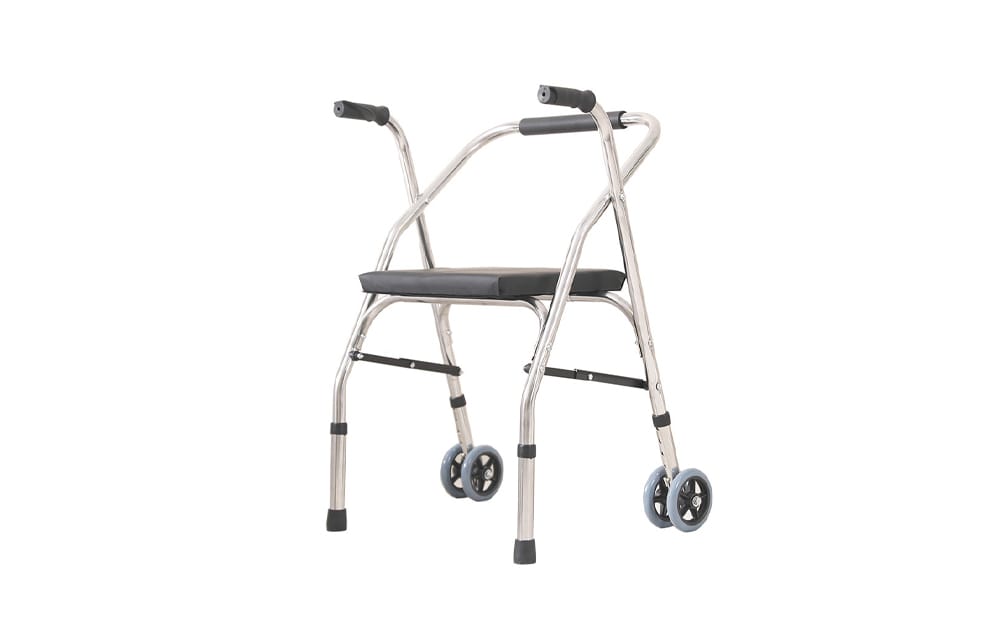
LOHO's rollator walker is described with adjustable handles, hand brakes, a folding frame, and a built-in seat for resting. The public page does not identify it as a wheelchair or transport chair. Buyers should not add that use to their own catalogue without appropriate manufacturer confirmation and supporting documentation.
The WHO's assistive technology overview places products within a wider provision and support system. For a seated resting feature, procurement should therefore plan access to assessment and instruction, not treat the seat as an accessory that any recipient can use in the same way.
Request Seat Measurements Separately From Handle Height
Ask for the seat height, usable width, usable depth, and any relevant back-support arrangement, with defined measurement points. Confirm whether the seat height is fixed or adjustable. Adjustable handles do not establish that the seat also adjusts, and a general frame-height specification may not describe either one accurately.
The LOHO product page does not publish a complete seat-dimension schedule or numerical user limit. Request those details for the quoted version rather than taking dimensions from a similar-looking product. If more than one size is available, identify the differences explicitly in the response and order.
Include the space between surrounding frame parts and controls where it affects the intended task. Nominal cushion width may not be the same as the clear usable space. A dimensioned photograph or drawing can help the assessing professional understand what the supplier measured without turning procurement into an individual clinical fitting decision.
Keep Fit Assessment With The Appropriate Professional
The person assessing the user should consider the complete walking and resting task, including access to controls and the ability to follow the instructions. Seat dimensions are inputs to that decision, not an automatic prescription. Avoid a catalogue claim that one seat height suits all adults or all older users.
The NHS walking-aid guidance discusses equipment choice and access to professional advice. In a procurement process, define who will fit and explain the supplied aid, and how users will obtain help if their needs change. Do not rely on a warehouse issue label to perform that role.
If a recipient cannot use the resting feature appropriately, the answer may require another configuration or another assessed aid. Adding a cushion, support, or improvised handle can change the arrangement. Obtain the appropriate review instead of adapting the seat informally to close a selection gap.

Ask How The Frame And Brakes Support Seat Use
Request the exact instructions for preparing the rollator before its seat is used. Those instructions should identify the deployed frame condition, braking procedure, permitted surfaces, and any relevant restrictions. Do not copy the operating sequence from a different mechanism simply because the brake levers look alike.
The Memorial Sloan Kettering rollator guide demonstrates component operation while explicitly recognising differences between products. Use such resources as background, then obtain the instructions for the actual supplied rollator. The manufacturer's directions and the care professional's instructions remain essential to handover.
LOHO's related rollator brake procurement guide covers brake evidence and service planning in more detail. For seat selection, the distinct question is whether the intended recipient can use the complete arrangement appropriately, including the preparation and transition between walking and resting.
Compare The Evidence Behind The Resting Feature
| Selection question | Information to request | Limit of the conclusion |
|---|---|---|
| How high is the seat? | Measurement points and fixed or adjustable range | A dimension does not prescribe an individual fit |
| How much usable space is available? | Seat and surrounding-frame dimensions | Nominal cushion size may not show all restrictions |
| What user limit applies? | Model-specific rating and relevant conditions | Appearance or tube size does not establish capacity |
| What must be secured first? | Deployed-frame and brake instructions | A general walking-aid leaflet may describe another design |
| Can a person be moved while seated? | Explicit intended use and restrictions | A seat does not create transport-chair approval |
| How is the seat maintained? | Cleaning, inspection, and replacement instructions | A removable part is not necessarily user-serviceable |
| What evidence supports performance? | Report identity, tested model, and scope | A standard number alone is not proof of testing |
The ISO catalogue entry for ISO 11199-2 on rollators identifies a relevant product-standard family. Ask which evidence, edition, and configuration support any supplier claim. Do not infer that the listed LOHO model has a particular certification merely because an applicable standard exists.
Where a document uses a different model reference, ask for the relationship to be explained and reviewed. A family-level description may need more detail before it can support the selected seat or frame arrangement. Keep that question open until an appropriate technical reviewer has the necessary information.
Include The Seat In Cleaning And Condition Checks
Ask how the seating surface, underside, attachments, and any back support should be cleaned and inspected. The permitted method may differ between materials. A wipeable-looking surface does not establish compatibility with the facility's disinfectant, concentration, application method, or required exposure.
During an unloaded sample review, examine whether the relevant surfaces can be accessed using the supplied instructions. Check how staff identify damage or looseness and which conditions require the equipment to be held for assessment. Do not conduct an informal person-loaded trial to investigate an uncertain attachment or frame lock.
If a seat component is replaceable, obtain the approved part reference and fitting route. A cushion or panel that fits the opening is not necessarily an acceptable substitute. Keep any replacement connected to the product identity and required checks before the rollator is considered for reissue.

Review The Route On Which Resting Is Expected
The intended environment affects the practical usefulness of a resting feature. A route may contain slopes, uneven surfaces, thresholds, crowding, or limited space to stop. The responsible assessment should consider where the rollator can be used according to its instructions, not simply whether a seat is available somewhere along the route.
For a care organisation, discuss how staff will recognise when a user's needs no longer match the issued aid. A recipient may initially manage the equipment but later require reassessment. The procurement record should identify the product and support route without attempting to prescribe future clinical decisions.
The LOHO rehabilitation equipment category shows the available mobility-product context. Choose the appropriate aid from confirmed information; do not promise that a rollator seat removes the need for another assessed seating or transport solution in every circumstance.
Make Seat Information Part Of The Distributor Handover
Include the exact model, verified dimensions and limits, instructions, fitting route, and service contact in the product information supplied to the customer. Avoid reducing this to a promotional statement about comfort. The customer needs to understand both the intended resting function and the boundaries of use.
Use LOHO's service page to confirm documentation and supported replacement components for the order. Ask how a changed seat or frame version will be identified in repeat supplies. A familiar product image should not become the only basis for matching parts across a mixed fleet.
Before approving an enquiry response, have the responsible reviewer check that every numerical value and use claim comes from the supplied model's information. If the seat dimensions or rating remain unconfirmed, say so in the internal review. Do not replace missing evidence with a broad assumption about standard rollators.
Conclusion
Select a rollator's resting feature through verified dimensions, intended use, individual assessment, and complete operating instructions. Seat appearance alone cannot establish fit, capacity, or suitability for transport.
Send LOHO the intended service setting and seat-information requirements to request a model-specific response. Include the questions your fitting and handover teams need answered before the aid is issued.
FAQ
Does handle-height adjustment also change seat height?
Not necessarily. Ask the supplier to identify each adjustment separately. Do not infer an adjustable seat from a description of adjustable handles.
Can a standard rollator be pushed with someone on its seat?
Do not assume that use is permitted. Follow the product's explicit intended use and restrictions, and obtain an appropriately assessed transport solution when seated movement is required.
Is a padded seat always the better choice?
No single feature decides suitability. Fit, intended use, material care, instructions, and the person's assessed needs matter more than padding alone.
Can an extra cushion be added to change the seat height?
Do not make that modification without appropriate manufacturer and clinical review. It can change the seating arrangement and may not be covered by the original instructions or evidence.
What should be done if the seat attachment feels loose?
Follow the withdrawal and reporting procedure and obtain a competent assessment. Do not use a seated person to test the condition or improvise a fastening repair.