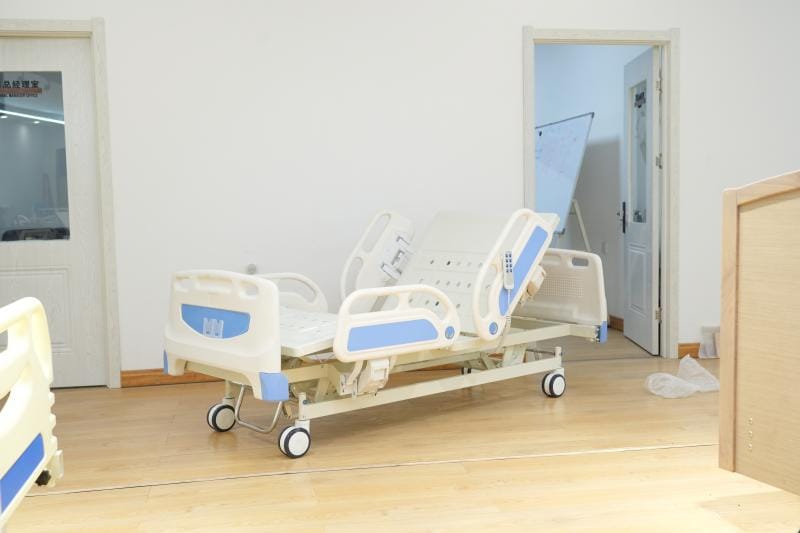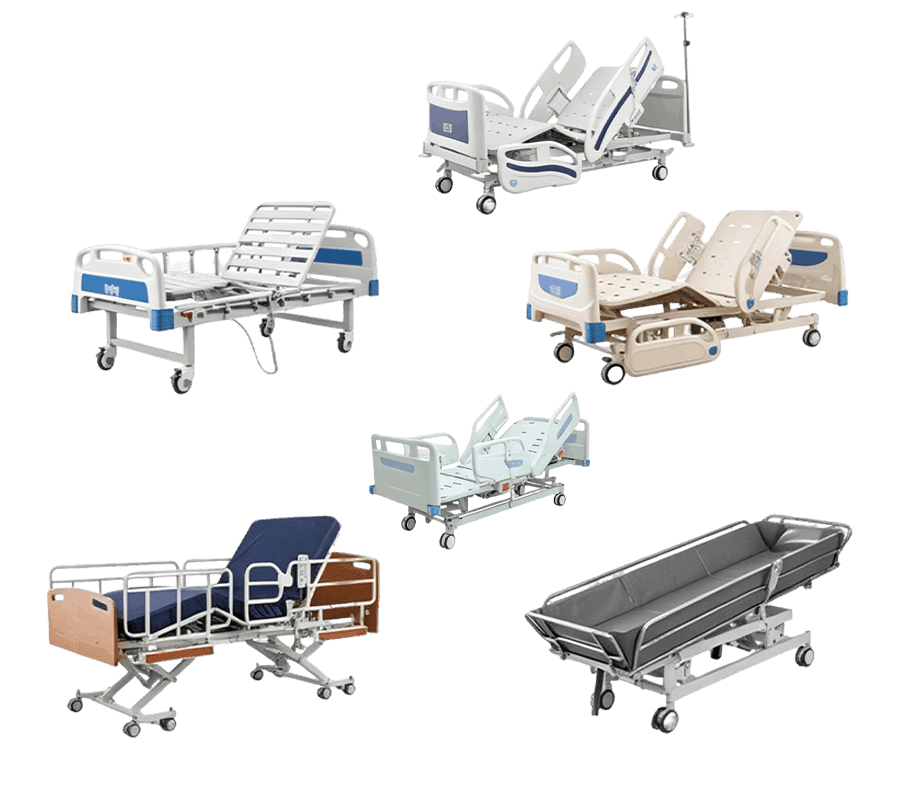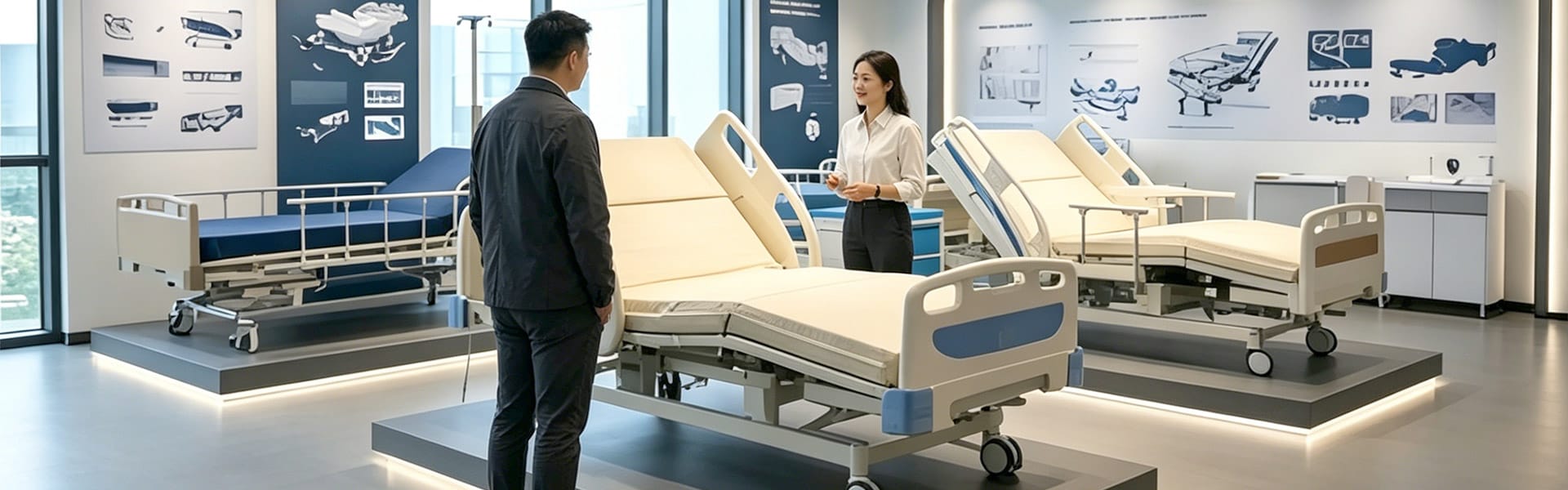
A hospital bed catalogue can look simple until you try to compare two models side by side.
One supplier describes a bed as “five-function.” Another calls a similar-looking model an “ICU electric bed.” A third groups the same general design under nursing care. The photographs may look almost identical, but the controls, height range, side rails, mattress, casters, and intended use can be very different.
That is why understanding the main types of hospital beds matters before you ask for a quotation or approve a tender specification.
The most common categories include manual, semi-electric, full-electric, ICU, low, nursing, home-care, bariatric, pediatric, and specialty medical beds. These categories often overlap. An ICU bed is normally electric. A nursing bed may also be a low bed. A home-care model may be manual or powered.
This LOHO Medical guide explains how the main hospital bed categories differ and how healthcare buyers can narrow the options without getting lost in product names.
Table of Contents
The Easiest Way to Understand Hospital Bed Categories
There are three practical ways to classify the types of hospital beds:
- By operation: manual, semi-electric, or full-electric
- By care setting: ward, ICU, nursing home, rehabilitation, or home care
- By patient or clinical need: bariatric, pediatric, low-bed, turning, birthing, or other specialty use
A single bed can belong to more than one group. For example, a full-electric low bed used in a nursing home could reasonably be described as an electric hospital bed, a low bed, and a nursing bed.
For a hospital procurement team or medical equipment distributor, the category name is only the starting point. The real decision comes down to how the bed will be used each day.
| Bed category | Where it is commonly considered | The first detail to confirm |
|---|---|---|
| Manual hospital bed | General wards, clinics, and projects that prefer mechanical adjustment | Which sections move and how much effort is required |
| Semi-electric hospital bed | Home care, long-term care, and selected ward applications | Which functions are powered and which remain manual |
| Full-electric hospital bed | Hospitals, rehabilitation, nursing care, and home care | Exact movements, controls, power supply, and emergency operation |
| ICU hospital bed | Intensive care and high-dependency units | Critical-care functions, access, braking, and service requirements |
| Low or nursing bed | Long-term care, elderly care, and rehabilitation | Minimum patient-surface height and daily care workflow |
| Home-care bed | Private homes and community care | Delivery access, assembly, controls, and local service |
| Bariatric or pediatric bed | Defined patient groups | Intended user range, dimensions, load rating, and matching mattress |
| Specialty medical bed | Maternity, turning, bathing, or procedure-specific care | Intended use, training, accessories, and technical documentation |
No hospital bed manufacturer should expect a buyer to select a model from this table alone. It simply helps identify which questions should come next.

Manual Hospital Beds: Straightforward, but Not All the Same
Manual hospital beds use cranks, levers, or other mechanical controls. Depending on the design, the backrest, leg section, or overall height may be adjustable.
They are often considered where bed movement is relatively infrequent, where electrical supply is uncertain, or where a facility prefers a simpler mechanical system. That does not mean every manual model is basic. Frame construction, crank layout, side rails, casters, brakes, and height adjustment can vary widely.
When reviewing manual types of hospital beds, look beyond the number of cranks.
A crank can be easy to operate in an open showroom and awkward once the bed sits beside a wall or cabinet. It may fold neatly beneath the frame, or it may project into a walkway. The amount of force needed also matters when caregivers will make repeated adjustments during a shift.
A useful manual-bed specification should state:
- Which movement each crank controls
- The adjustment range
- Whether the height is fixed or adjustable
- Where the cranks are stored
- Whether mechanical parts can be replaced separately
- Which mattress and side rails belong with the model
LOHO Medical lists a dedicated range of manual hospital beds. Buyers comparing LOHO models should still request the technical drawing and exact function list for the product being considered.
Semi-Electric Hospital Beds: A Useful Middle Ground
A semi-electric hospital bed combines powered and manual adjustment. A common arrangement uses electric controls for the backrest and leg section while the overall bed height remains manual.
That is only one possible configuration.
Different medical bed suppliers may use “semi-electric” for different combinations, so the name should never stand alone in a purchase order. Ask the supplier to label every movement as electric, manual, fixed, or optional.
Also ask what happens during a power interruption. If the functions used most often depend on electricity, the care team needs to know which movements remain available and how the user can be supported safely.
Semi-electric types of hospital beds can make sense when a project needs powered positioning without a fully electric frame. They do, however, require both mechanical and electrical maintenance planning. Replacement handsets, cables, control boxes, actuators, and crank components should be identified before the order is finalized.
Full-Electric Hospital Beds: Convenience Depends on the Controls
Full-electric hospital beds use powered controls for the main movements included in the model. These often include backrest, leg-rest, and height adjustment. More advanced models may add forward and reverse tilt, coordinated positions, or other care functions.
The phrase “full-electric” does not tell you how many movements are included. It does not confirm that a battery is supplied, that controls can be locked, or that emergency lowering works in a particular way.
This is where a good hospital bed manufacturer should provide a clear movement chart rather than relying on a marketing name.
When comparing full-electric types of hospital beds, confirm:
- Every available movement and its range
- Which controls are available to the patient and caregiver
- Whether individual functions can be locked
- Voltage, frequency, and plug type
- Battery or backup arrangement
- Emergency stop or lowering method
- Cable routing and protection
- Availability of replacement electrical parts
The number of motors is useful technical information, but it is not the same as the number of functions. Two beds with the same motor count can move differently because of their frame and actuator arrangement.
LOHO’s electric hospital bed range includes models with different configurations. A buyer should compare the actual movement list rather than choosing a LOHO bed by function count alone.
ICU Beds Are Built Around Critical-Care Workflow
An ICU hospital bed is more than an electric ward bed with extra buttons.
Critical-care teams may need faster access around the patient, emergency positioning, central braking, battery operation, control lockout, steering support, angle indicators, or other features tied to the unit’s workflow. Some projects may also specify integrated weighing or additional monitoring-related options.
Not every ICU needs the same package, and not every model marketed as an ICU bed includes the same equipment.
The most useful way to compare ICU-type hospital beds is to map each requested feature to a specific task.
Can staff reach the relevant control during an emergency? Is there enough space at the head end for equipment and procedures? Can the bed be moved with the devices normally attached to it? Does the central brake operate the way the facility expects? Can the biomedical team identify and replace key components?
For adult medical beds within its scope, IEC 80601-2-52:2026 addresses basic safety and essential performance. The applicable edition, national adoption, and model-specific evidence still need to be confirmed for the destination market.
For a hospital furniture manufacturer or hospital equipment supplier, calling a product an “ICU bed” is not enough. The quotation should identify the exact configuration, accessories, mattress, rail system, documentation, and service package.
Low Beds and Nursing Beds Reflect a Different Kind of Daily Care
Low beds and nursing beds are often mentioned together, but they describe different things.
A low bed is defined mainly by how close the platform can move to the floor. A nursing bed is defined more by the care setting and the daily routines it is expected to support. One model can be both.
Low Hospital Beds
The minimum platform height is only part of the story.
Once a mattress is added, the patient surface is higher. Mattress thickness also changes the effective height of the side rails. Under-bed clearance may become more limited when the frame is fully lowered, which can affect access for a mobile hoist or cleaning equipment.
A low bed can be useful within an appropriate care plan, but it should not be presented as a universal answer to fall risk. The individual user, mattress, transfer method, room layout, staffing, and local policy all matter.
Nursing Beds
Nursing beds are usually designed for longer-term care in nursing homes, rehabilitation facilities, assisted-living settings, or private homes.
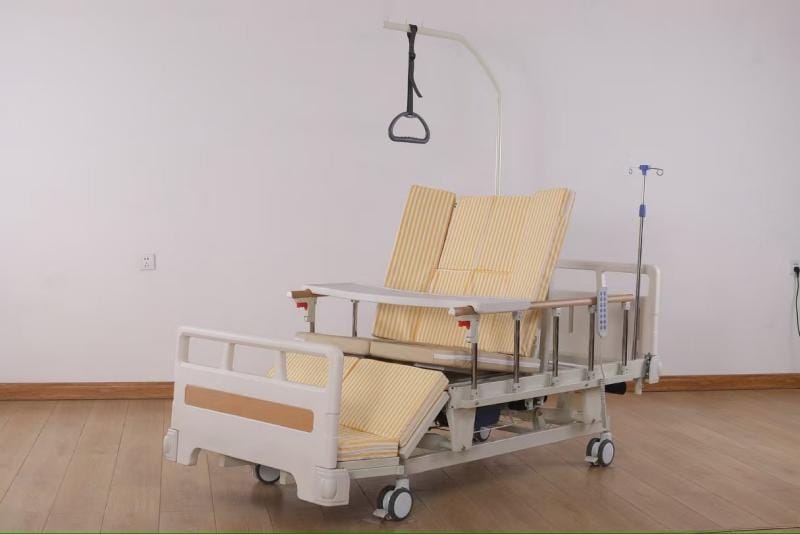
Depending on the model, they may offer powered positioning, low height, lateral turning, chair conversion, or other care-related functions. These features should always be reviewed with the matching mattress, side rails, and controls.
When comparing nursing types of hospital beds, think about a normal day rather than a brochure.
Can caregivers change bedding without fighting the rail mechanism? Is the handset easy to understand? Can a hoist approach the bed? Does the mattress move properly when the backrest or leg section changes position? Can replacement parts be ordered later by model and part number?
LOHO Medical organizes nursing products separately from its standard hospital bed categories. Buyers can review the electric nursing bed range and manual nursing bed range before discussing the exact configuration with the LOHO team.
Home-Care Beds Have to Fit the Building as Well as the User
Home care is a setting, not one fixed bed type.
The types of hospital beds used at home may be manual, semi-electric, full-electric, low, or nursing beds. The right choice depends on the person receiving care, the caregiver, the room, the delivery route, the electrical supply, and the support available after installation.
A room can be large enough for the bed while the bed is impossible to deliver.
Measure the route from the unloading point to the final room, including the entrance, hallways, internal doors, elevator, stair landing, and tightest corner. Ask for the dimensions of the largest package and the longest rigid component, not only the assembled frame.
The person operating the bed matters too.
A control layout that feels obvious to trained hospital staff may be confusing to a family caregiver. Clear labels, simple instructions, safe cable routing, and a realistic service plan are especially important in a residential setting.
A responsible medical bed supplier should explain how the bed is delivered, what needs to be assembled, which tools are required, and who should carry out the installation.
For buyers considering LOHO hospital beds for home-care projects, the inquiry should include doorway limits, required functions, local voltage, mattress needs, caregiver requirements, and the expected service arrangement.
Bariatric, Pediatric, and Specialty Beds Need Their Own Specifications
Some types of hospital beds should not be treated as minor variations of a standard adult model.
Bariatric Hospital Beds
Bariatric beds generally have a wider patient surface and a model-specific load capability. Selection should not be based on patient weight alone.
The room, doorway, elevator, transfer equipment, mattress, rails, and floor layout all need to work with the wider frame. Buyers should also ask the hospital bed manufacturer to define the load terms used in the technical sheet.
Safe working load, maximum patient weight, static test load, and dynamic load are not automatically interchangeable.
Pediatric Medical Beds
A pediatric medical bed is not simply a shorter adult bed.
The intended age or size range, mattress fit, rail spacing, access points, controls, warnings, and applicable requirements may all differ. Pediatric beds need a separate specification and review process involving the appropriate clinical, biomedical, procurement, and regulatory teams.
Specialty Medical Beds
Specialty beds are designed around a particular care task. Examples may include birthing beds, bathing beds, lateral-turning beds, rehabilitation beds, orthopedic beds, and chair-conversion nursing beds.
Each raises its own questions.
A bathing bed needs a clear approach to drainage, moisture protection, cleaning, and transfers. A lateral-turning bed depends on a compatible mattress and defined operating routine. A birthing bed has its own sections, accessories, and caregiver access requirements.
A hospital furniture supplier should not simply add accessories to a general ward bed and present it as a specialist product. When a function is central to the project, it should be part of the bed’s intended design and supported by the relevant documentation.
The Mattress, Side Rails, and Frame Must Work as One System
Bed type is only half the decision.
The frame, mattress, rails, casters, controls, and accessories need to work together. The U.S. FDA’s hospital bed guidance describes a hospital bed system as the frame, mattress, bed rails, and other compatible accessories. Its guidance encourages manufacturers and healthcare facilities to consider component compatibility and the spaces created within the system.
This becomes especially important when:
- The mattress is purchased from another supplier
- A pressure-relief overlay is added
- Side rails are replaced
- A bed extension is used
- An aftermarket accessory is installed
A mattress with the right nominal length and width can still be unsuitable if it is too thick, too compressible, or unable to articulate correctly with the bed.
Similarly, side rails that look compatible may use different mounting points or create different gaps around the mattress.
Before approving any of the types of hospital beds, request the matching mattress specification, rail model, accessory list, and complete technical drawing.
LOHO buyers can also review the company’s medical bed accessories alongside the relevant hospital bed or nursing bed category.
What a Hospital Bed Manufacturer Should Confirm Before You Order
A professional quotation should make it easy to understand what is being supplied.
The World Health Organization’s medical-device technical specification guide explains how technical specifications can support tendering, procurement, purchasing, maintenance planning, and training. A clear specification also prevents several suppliers from answering different versions of the same request.
Before approving a hospital bed supplier, ask for the following.
A Model-Specific Function List
Do not accept “three-function,” “five-function,” or “multifunction” without a description of each movement and its range.
A Complete Dimensional Drawing
The drawing should distinguish the mattress platform from the complete frame and show the relevant height range, side-rail position, and any extension.
The Matching Mattress and Rail Specification
These components should be identified as part of the bed system, not treated as interchangeable generic items.
Electrical Information
For powered beds, confirm voltage, frequency, plug, controls, battery arrangement, emergency operation, and replacement-part references.
Cleaning and Maintenance Documents
Ask for cleaning instructions, preventive-maintenance guidance, troubleshooting information, and illustrated parts lists.
Packaging and Assembly Details
Request the number of packages, dimensions, gross weights, assembly status, required tools, and the size of the largest rigid component.
Model-Specific Technical and Regulatory Documents
The document should identify the legal manufacturer, product model, scope, and relevance to the destination market. A certification logo in a brochure is not enough.
This is where the difference between a product catalogue and a reliable hospital bed manufacturer becomes clear.
How LOHO Organizes Its Hospital Bed Range
On the LOHO Medical website, the product range is divided by operating method and care application rather than placed under one broad category.
Buyers can explore:
- Electric hospital beds
- Manual hospital beds
- Electric nursing beds
- Manual nursing beds
- Hospital furniture
- Medical bed accessories
This structure helps buyers begin with the broad care setting and then compare the exact model, movement list, dimensions, mattress, side rails, and accessories.
A LOHO product inquiry should include more than the requested quantity. It is helpful to send:
- The intended care setting
- The patient group
- Required movements
- Room and doorway limits
- Preferred mattress and rail configuration
- Local electrical supply
- Destination country
- Required documents
- Expected order quantity
That gives LOHO Medical enough context to identify relevant models and highlight the specifications that still need to be confirmed.

Common Mistakes When Comparing Hospital Bed Types
Choosing by Function Count
Two suppliers may count functions differently. Compare actual movements and ranges instead of choosing a bed because one number is larger.
Assuming Electric Always Means Better
Powered adjustment can be useful, but the right choice also depends on how often the bed moves, who operates it, the available power supply, and the facility’s maintenance capacity.
Treating Home Care as One Category
Home-care types of hospital beds can be manual, semi-electric, or full-electric. The house, caregiver, and local service arrangement often decide which model is practical.
Ignoring Packaged Dimensions
The assembled bed may fit the room but fail to pass through an elevator or doorway. Ask for the largest package and the longest rigid part.
Buying the Mattress Separately Without Checking Compatibility
A small difference in thickness or compressibility can change how the mattress works with the rails and moving platform.
Choosing a Complex Bed Without a Service Plan
Advanced functions add value only when the facility can clean, inspect, troubleshoot, and obtain replacement parts for the bed.
Accepting Vague Industry Claims
Terms such as “international standard,” “medical grade,” or “heavy duty” should be supported by model-specific information. Ask the hospital equipment supplier to explain exactly what each claim means.
Frequently Asked Questions About Types of Hospital Beds
What are the main types of hospital beds?
The main categories include manual, semi-electric, full-electric, ICU, low, nursing, home-care, bariatric, pediatric, and specialty medical beds.
A single model may fall into more than one category.
How many types of hospital beds are there?
There is no fixed number because hospital beds can be classified by operating system, care setting, patient group, or special function.
For procurement, a clear intended use and technical specification are more helpful than a numbered list.
What is the difference between manual and electric hospital beds?
Manual beds use cranks, levers, or other mechanical controls. Electric beds use powered actuators for the movements included in the model. Semi-electric beds combine both systems.
What type of hospital bed is used in an ICU?
ICUs generally use advanced electric beds configured for critical-care workflow. The exact requirements may include tilt, CPR-related controls, central braking, battery support, lockout, or other features depending on the unit.
Is a nursing bed the same as a hospital bed?
The categories overlap, but nursing beds are usually designed around longer-term daily care in nursing homes, rehabilitation settings, assisted-living facilities, or private homes.
Which types of hospital beds are suitable for home use?
Manual, semi-electric, full-electric, low, and nursing beds can all be considered for home care when the intended use, room, caregiver needs, delivery route, and service plan are suitable.
Is a low bed always safer?
No single bed configuration is right for every user. Low height may support some care plans, but mattress height, transfer method, room layout, supervision, and individual assessment still matter.
How should a buyer compare hospital bed manufacturers?
Send every supplier the same care setting, function list, dimensions, mattress and rail requirements, electrical information, packaging needs, documentation requirements, and service expectations.
Then compare the exact product configuration rather than the category name alone.
Find the Right LOHO Bed for Your Project
Choosing among the different types of hospital beds becomes much easier once the intended use is clear.
Start with the people and the setting. Then define the movements, dimensions, mattress, side rails, electrical requirements, cleaning routine, packaging, and service support.
LOHO Medical offers manual and electric hospital beds, nursing beds, hospital furniture, and related accessories for different care environments. To discuss a model, send your project requirements through the LOHO contact page.
A detailed inquiry helps the LOHO team understand what the bed needs to do, where it will be installed, and which technical details should be confirmed before a sample or production order moves forward.
Conclusion
The names used for the types of hospital beds are helpful, but they are only the beginning.
Manual, semi-electric, full-electric, ICU, low, nursing, home-care, bariatric, pediatric, and specialty beds are designed around different users and workflows. Several labels may apply to the same model.
A reliable buying decision starts with the care setting, not the longest feature list.
Define who will use the bed, who will operate it, which movements are genuinely needed, how it will fit the room, and how the facility will maintain it. Then review the complete bed system, including the mattress, side rails, controls, casters, accessories, packaging, and documentation.
That is the approach LOHO Medical recommends for buyers comparing hospital bed options across hospitals, nursing facilities, rehabilitation centers, and home-care projects.