Table of Contents
A folding rollator walker should be selected by its usable configuration as well as its storage dimensions. The buyer needs to know how the frame folds, what keeps it secured, which accessories remain attached, and how staff confirm that it is ready for walking again. A compact catalogue photograph does not answer those questions.
For distributors and care organisations, the main risk in a folding specification is ambiguity. Folded width may exclude protruding wheels or accessories, while an easy-to-fold claim may assume an unloaded seat and a particular hand position. This guide turns those uncertainties into a practical sample and documentation review.
Define The Journey Before Comparing Folded Sizes
Start with where the rollator will be used, stored, and transported. A home-care service loading a vehicle has different constraints from a clinic storing several units in an equipment room. Record the doorways, storage positions, handling tasks, and surfaces relevant to the proposed service.
Decide whether the equipment needs to stand when folded, lie flat, or fit within a particular compartment. These are requirements to confirm, not characteristics that every folding design possesses. Also establish who will move it and whether the task includes lifting rather than rolling.
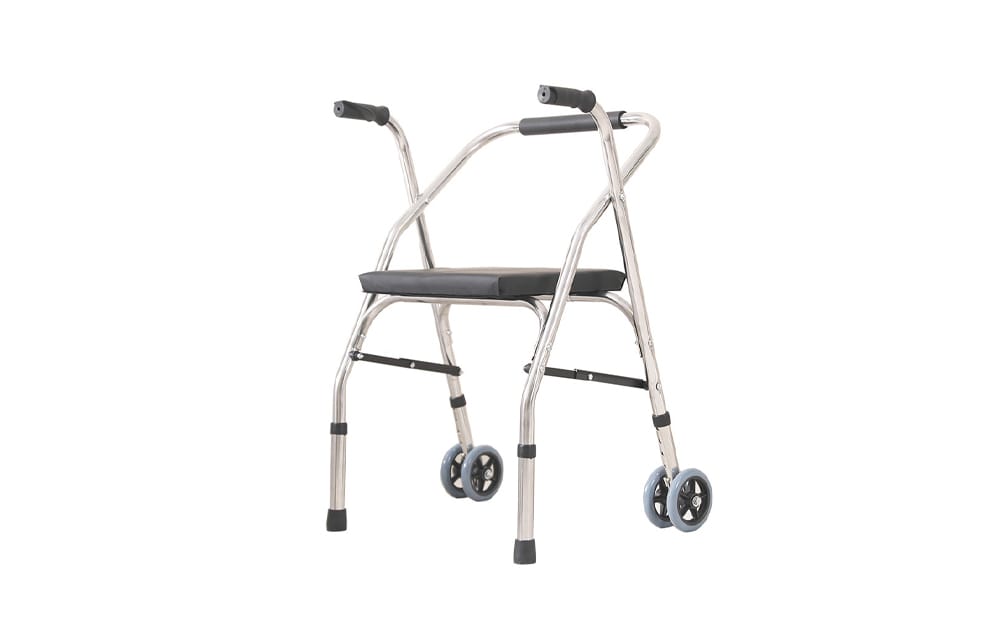
LOHO's walker and rollator product page describes a folding structure, adjustable handles, a seat, and hand brakes. It does not publish a complete folded-envelope drawing. Buyers with limited storage or vehicle space should request that information for the quoted configuration rather than estimate it from the image.
Ask For The Full Folded Envelope
Request maximum length, width, and height in the agreed storage position, with units and a photograph showing the measurement points. Ask which accessories are installed and whether handles are adjusted or removed. Without that context, two suppliers may be measuring different arrangements.
Include projecting brake levers, wheels, bags, and any other supplied parts in the review. A narrow main frame does not necessarily represent the space needed to place or remove the whole rollator. Allowance for safe handling belongs in the storage plan even though it is not part of the product's nominal dimensions.
Record both the deployed and folded configurations. The compact storage position should not hide a mismatch at the point of use. A rollator that fits the store but cannot be used appropriately in the intended environment has not met the requirement.
Understand What Must Happen Before Folding
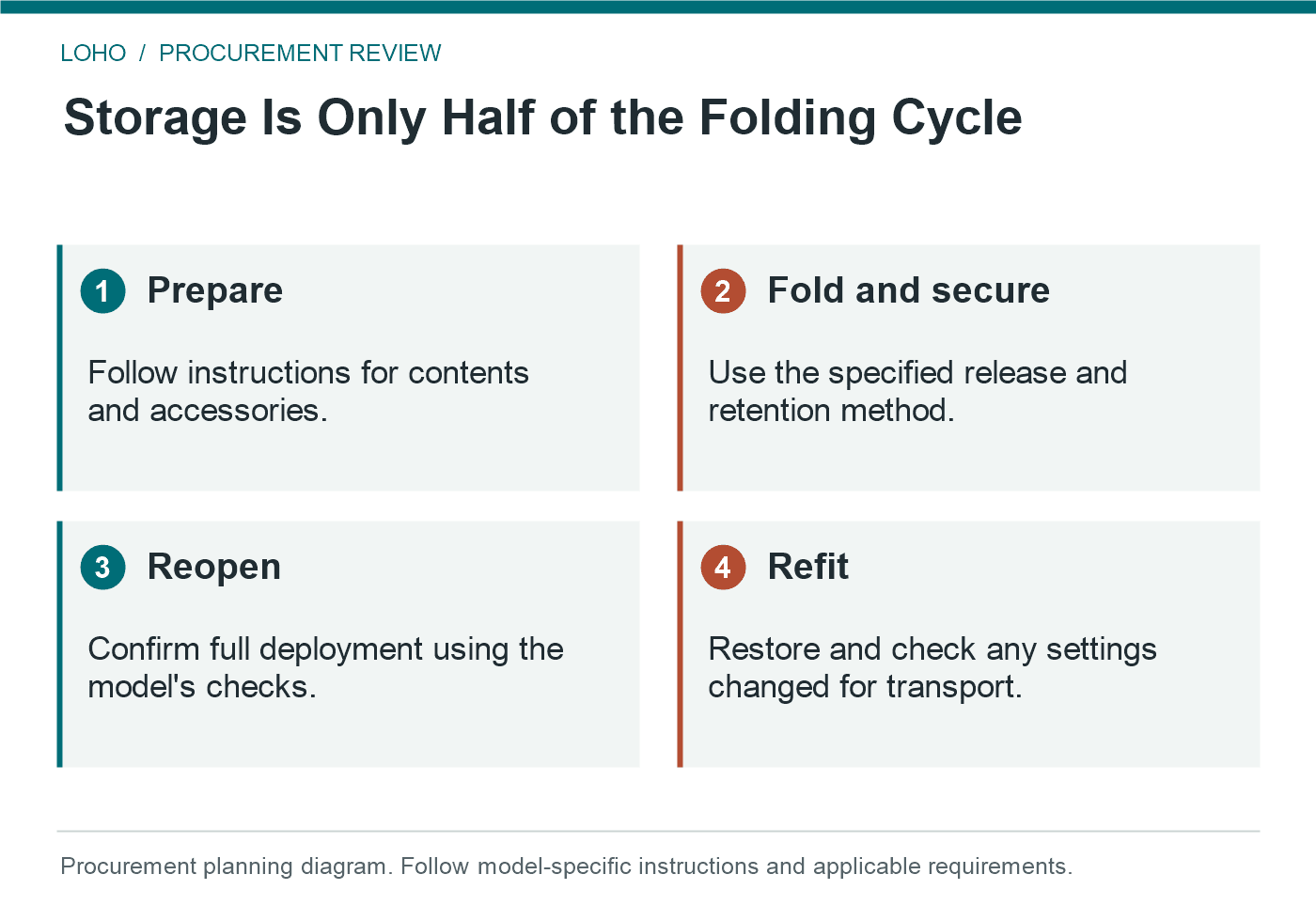
Obtain the manufacturer's sequence, including whether bags must be emptied, accessories removed, brakes set, or handles repositioned. Keep people clear of the mechanism as instructed. Do not adopt the sequence from another brand or infer it from a short sales video.
The Memorial Sloan Kettering guide to rollator operation discusses preparation, folding, and reopening, and explains that instructions differ between products. It is useful background, but the actual LOHO mechanism and instructions must be confirmed separately rather than copied from the illustrated equipment.
During a sample review, ask the intended staff to follow the supplied directions without additional verbal hints. If they cannot identify the release point or secure state, record the difficulty and ask for clarification. A demonstration by someone familiar with the product can conceal an instruction gap faced by a new user.

Review Reopening As A Separate Task
Unfolding is not complete simply because the frame looks wide enough. Staff need a defined way to confirm that the structure is fully deployed and secured before it is issued or used. Ask the supplier to identify the relevant visual or functional checks for the model.
Include the seat, handles, accessories, and brakes in the return-to-use review as directed by the instructions. This is especially important if any part has been removed or repositioned for transport. An adjustment made for storage should not silently become the setting for the next user.
The FDA's human factors guidance provides a framework for examining tasks in their use environment. Apply that thinking to the transition from stored equipment to walking aid. A local trial can identify practical issues, but it is not proof of formal usability validation.
Compare Transport And Storage Requirements Together
| Review point | Question for the supplier | Sample-review record |
|---|---|---|
| Folded envelope | What are the maximum dimensions with supplied accessories? | Measured configuration and stated tolerances |
| Handling | Which points may be used for lifting or carrying? | Staff task and permitted method |
| Retention | How is the folded position secured? | Confirmation that the specified mechanism works |
| Reopening | How is full deployment confirmed? | Instruction followed and check completed |
| Accessories | What must be removed or repositioned? | Parts list and storage arrangement |
| Transport protection | Which components require protection? | Packing method and inspection on arrival |
| User setup | Which adjustments need restoring? | Handover responsibility and fitting route |
Evaluate these points with an unloaded sample and within its instructions. Do not put a person on the seat to test an uncertain lock or use the frame in a partly folded condition. Any question about safe operation should be resolved before user evaluation.
Retain the configuration photographs with the procurement record. If a later order changes a bag, wheel, handle, or folding component, ask whether the storage envelope and instructions remain valid. A familiar product name is not enough to close that change review.
Plan Handling Without Assuming Portability
A foldable product is not necessarily easy for every staff member or user to lift. Request the product mass and approved handling points, then review the actual movement task. Avoid describing the equipment as lightweight without a relevant, verified value and a clear context.
The HSE's moving and handling guidance is relevant when equipment itself must be moved. The practical assessment should include the route, available space, and the people performing the task. Folding may reduce volume while doing little to simplify an awkward lift.
For vehicle transport, confirm the operator's requirements for securing unoccupied equipment. Do not present a rollator as a passenger seat or assume its walking configuration is suitable for use during travel. Storage suitability and transport restraint are separate questions for the relevant instructions and transport provider.
Protect Components During Repeated Storage
Designate a storage position that follows the product instructions and keeps equipment from becoming an obstruction. Ask whether units may be stacked or hung; do not assume either practice is acceptable. Pressure from neighbouring equipment may act on controls or accessories that were not intended as storage supports.
Include a way to distinguish ready-to-use stock from items awaiting inspection or cleaning. A folded unit is harder to inspect at a glance, so its status should not depend on someone recognising a defect from across the room. Keep the equipment identity and documents accessible.
The LOHO rehabilitation equipment category can help buyers review the wider mobility range, but storage instructions should remain model-specific. Crutches, walkers, and rollators need their own handling and release arrangements rather than one generic mobility-aid procedure.
Connect The Folding Design To Supplier Evidence
Ask which safety and performance evidence applies to the supplied rollator and its configuration. The ISO catalogue entry for ISO 11199-2 on rollators identifies a relevant product-standard family. Its existence does not establish that a quoted model has been tested or certified to it.
Request the document identity, model scope, edition, and any relevant amendments when a supplier makes a standards claim. A test on a different frame or accessory arrangement may need a technical explanation before it can support the current purchase. Do not perform informal strength testing to replace missing evidence.
Discuss documentation and replacement support through LOHO's service page. In particular, ask how to identify the folding and locking components if service is needed. The storage process should not depend on an unrecorded repair or a replacement part chosen only by appearance.
For repeated deliveries to several sites, keep a site-specific storage record rather than assuming that one successful trial covers every location. Note the cabinet or vehicle compartment used, the required orientation, and any parts removed under the instructions. This lets a receiving team identify a genuine configuration difference instead of discovering it when the equipment will not fit its assigned space. Review the record when either the product or the storage arrangement changes.
Conclusion
Choose a folding rollator through the complete cycle: use, fold, store, transport, reopen, and refit. Request configuration-specific dimensions and instructions, then evaluate the cycle with the people responsible for it.
Send LOHO your storage envelope and transport requirements with the intended rollator configuration. Ask for a dimensioned response and the model's folding instructions before approving the order.
FAQ
Does folded width include every projection?
Not necessarily. Ask the supplier to define the measurement and include accessories, controls, and wheels in the maximum envelope for the intended storage position.
Can a folded rollator be stored upright?
Only if that arrangement is supported by the model's instructions and the local storage assessment. Do not assume that every folded frame is self-supporting.
Should handle settings be restored after transport?
Any changed setting needs to be checked before use, following the instructions and appropriate fitting process. A transport setting is not automatically the correct user setting.
Can the rollator carry a seated person while being moved?
Do not infer that use from the presence of a seat. Follow the product's intended use and restrictions; a walking aid is not automatically a transport chair.
What if a folding lock is difficult to engage?
Do not force or improvise the mechanism. Keep the unit out of use until the condition and correct procedure have been assessed through the responsible service route.