Table of Contents
Crutch hand grips should be replaced with parts confirmed for the specific crutch model and fitted according to its instructions. A grip that appears to fit is not necessarily an acceptable replacement: attachment, adjustment hardware, material, and the resulting hand position all matter. Procurement teams managing loan stock need a controlled replacement process, not a collection of visually similar spare parts.
This guide concerns underarm-crutch grips and their supporting assemblies. It is intended for distributors, rehabilitation-equipment stores, and facility teams responsible for purchasing and reissuing equipment. Clinical fitting and weight-bearing instructions remain the responsibility of the treating professional.
Identify The Grip Assembly Before Ordering
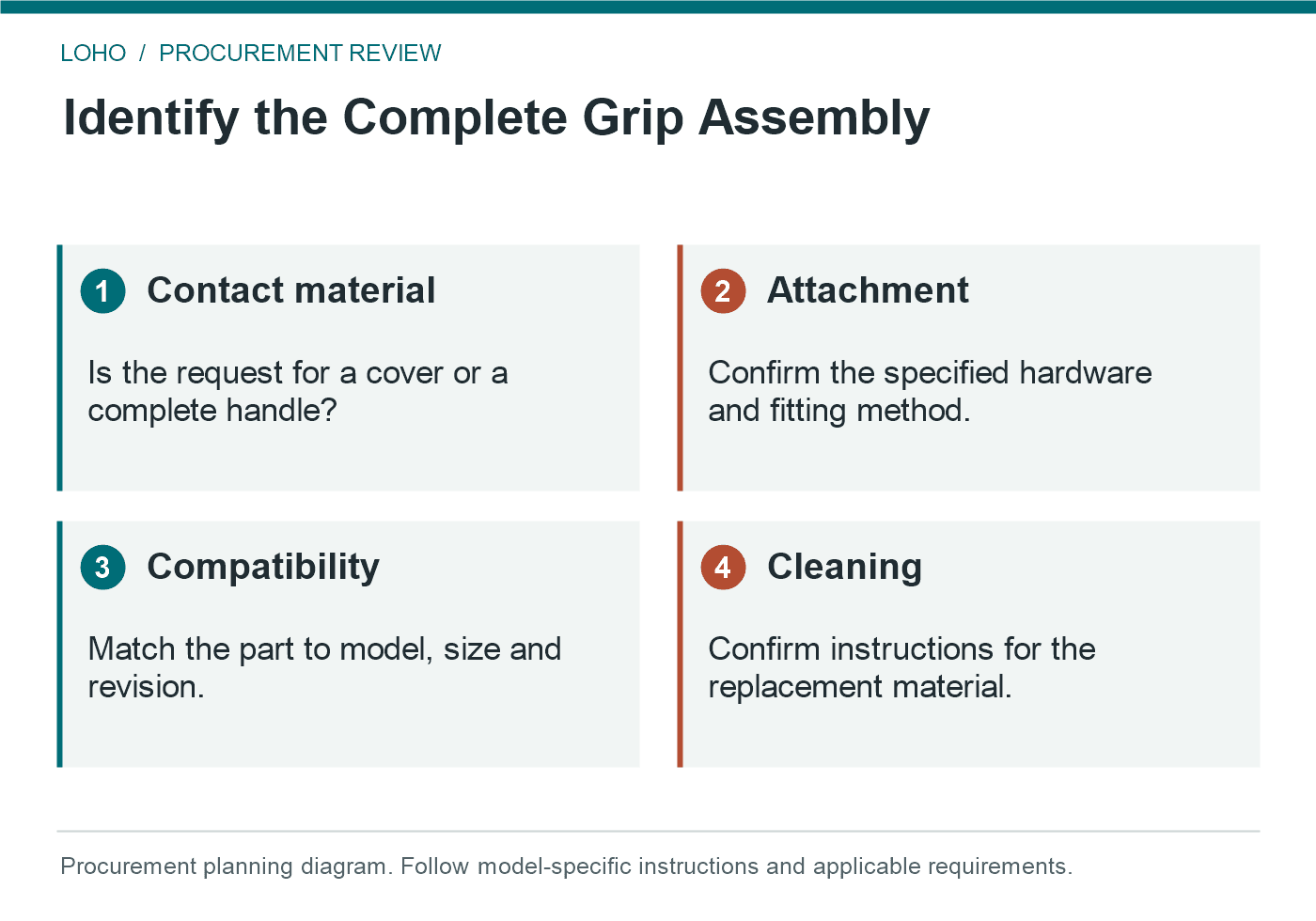
Start by establishing what the supplier means by hand grip. The term may describe the outer contact material, the complete handle, or an assembly including fasteners. Record the model, size, revision where available, and photographs of the existing arrangement before requesting a replacement.
LOHO's lightweight underarm crutches have separately adjustable overall height and handgrip position. A replacement enquiry therefore needs to distinguish the handle setting from the crutch's length setting. The public page does not provide a universal replacement-grip part number, so compatibility must be confirmed for the supplied version.
Ask whether left and right components differ and whether the same part is used across the available crutch sizes. Do not infer interchangeability from a shared product name. A written answer identifying the approved part gives stores staff something reliable to use on the next order.
Separate Comfort From Functional Suitability
A softer grip is not automatically a suitable upgrade. Its shape, thickness, surface behaviour, and attachment may alter how the user holds the crutch. An aftermarket cover can also conceal damage or make the condition of the underlying assembly harder to inspect.
The AAOS guidance on crutches, canes, and walkers explains that weight during crutch use should be borne through the hands rather than the armpits. For buyers, this reinforces why the handle deserves specific attention. It does not establish that a particular grip material will suit every user.
Where a user reports discomfort, route the issue to the appropriate clinician rather than treating it solely as a spare-parts request. The problem may involve fitting, technique, the person's condition, or equipment choice. A different cushion should not be used to bypass that assessment.
Recognise When Replacement Needs More Than A New Cover
Inspect the assembly according to the manufacturer instructions and the organisation's procedure. Report movement, damage, missing hardware, or difficulty securing the setting. A new outer grip cannot correct an underlying problem with the handle support or adjustment mechanism.
If the condition is uncertain, separate the crutch from ready-to-issue stock until it has been assessed. Label the issue clearly enough that another staff member will not mistake the equipment for a cleaned and approved unit. Avoid makeshift repairs that are absent from the manufacturer instructions.
The MedlinePlus crutch-use instructions place fitting and use within the care team's guidance. After a replacement changes the gripping arrangement, the equipment's suitability for the intended user still needs the appropriate fitting check. Mechanical completion and clinical readiness are different decisions.
Request A Part-Level Compatibility Record
The best spare-parts response identifies both the replacement and the equipment it is approved to fit. Ask for the part reference, applicable model or production range, supplied hardware, fitting instructions, and any required post-replacement checks. A photograph alone is insufficient when several versions look alike.
If a replacement differs from the original, ask the supplier to explain the change and confirm the approved application. Keep that response with the stock record. Do not allow a substituted component to become the default merely because it was available during one urgent repair.
| Procurement check | Useful supplier response | What it prevents |
|---|---|---|
| Component identity | Part reference and assembly contents | Ordering only a cover when a full handle is needed |
| Equipment match | Applicable model, size, and revision | Assuming visually similar parts are interchangeable |
| Fixing method | Specified hardware and installation instructions | Reusing unsuitable or incomplete fasteners |
| Cleaning compatibility | Permitted products and methods | Damaging replacement material during reprocessing |
| Release checks | Required inspection and function checks | Treating installation alone as approval for use |
| Future availability | Agreed ordering and substitution process | Unrecorded changes across a loan fleet |
For a mixed fleet, store parts by verified compatibility rather than by colour or approximate diameter. Staff should be able to identify the intended equipment without opening several bags and comparing pieces at the repair bench.
Align Cleaning With The Replacement Material
Request cleaning information for the complete handle assembly, including any interfaces beneath removable material. A general description such as rubber does not establish compatibility with the facility's disinfectant, concentration, contact time, or method. Obtain instructions for drying and reassembly where those steps apply.
The CDC's disinfection recommendations provide the healthcare context for appropriate product use. The replacement decision still requires material-specific information from the manufacturer. Do not extend a chemical approval for a metal frame to every grip fitted to it.
During the sample review, assess whether staff can inspect and clean the relevant surfaces using the permitted process. Do not cut, strip, or force a grip off merely to see underneath it. If removal is part of maintenance, the supplier should explain how it is performed and whether the removed part can be reused.
Keep Repair And Reissue Decisions Separate
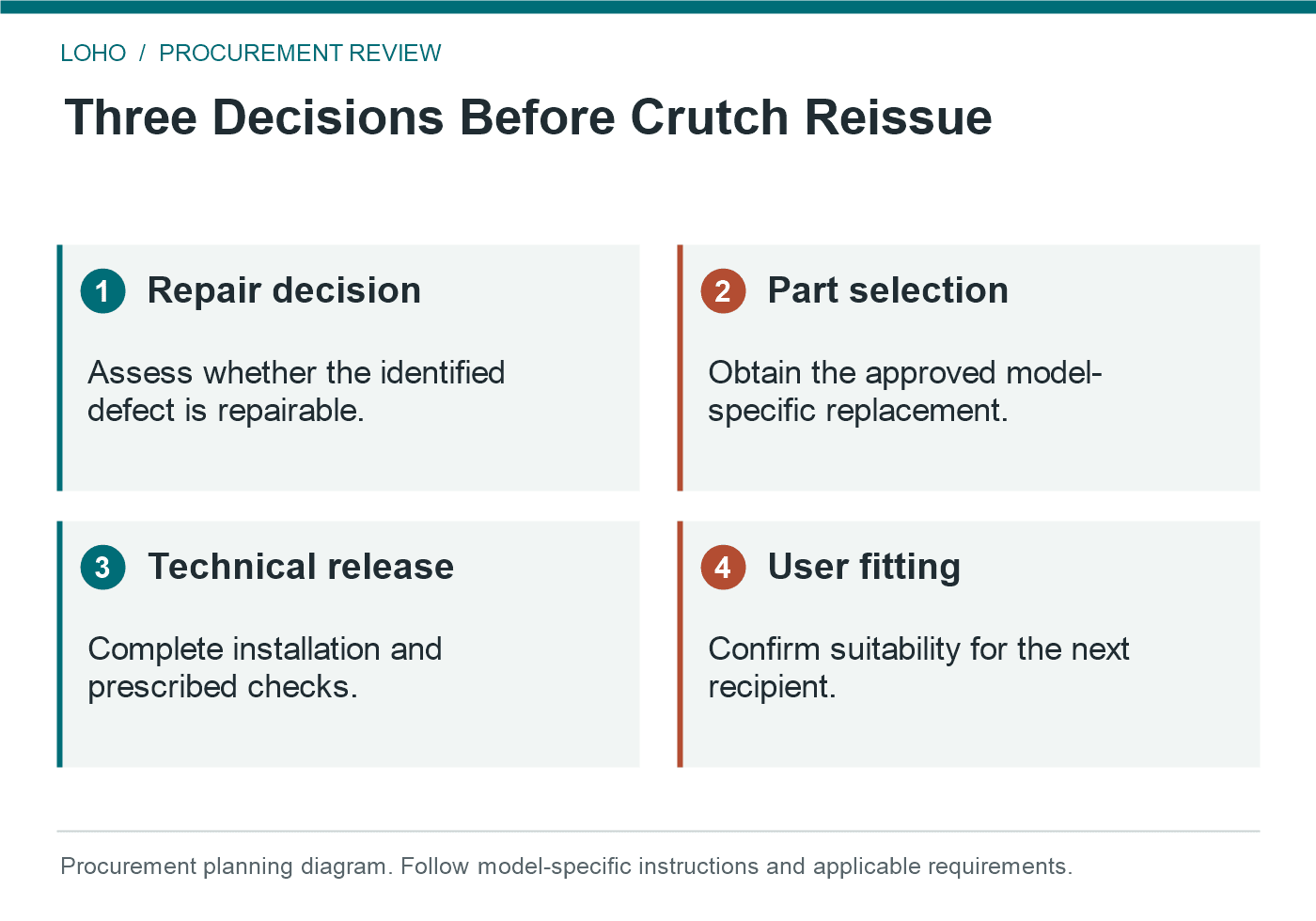
A practical workflow has three distinct decisions: whether the equipment is repairable, whether the repair meets its technical requirements, and whether the crutch is suitable for the next user. Different staff may hold responsibility for each decision. Record their roles before the loan stock enters service.
For example, a stores team may receive a crutch with a damaged hand contact surface. A competent maintainer confirms the correct replacement and completes the prescribed checks. The issuing professional then checks fit for the recipient. This is an illustrative workflow, not a claim about a particular LOHO delivery or service arrangement.
The WHO's assistive technology overview treats these products within a wider system of services and support. For procurement, that means replacement availability matters alongside the initial crutch order. A spare component is useful only when the organisation can identify, fit, and release it appropriately.
Review Samples Before Standardising Spare Stock
Ask for a representative replacement kit and its documentation before ordering a large quantity. Compare it with an identified crutch from the intended stock. Evaluate packaging labels, component completeness, instruction clarity, and the permitted installation process; do not improvise a load test or use an unapproved modification.
Record the accepted part reference and any differences found. If a sample is accepted only after the supplier changes its instructions or hardware, preserve the revised version as the basis for the production order. An old photograph should not remain the sole purchasing reference.
The LOHO rehabilitation equipment range includes different mobility products. Keep spare-parts records product-specific. A contact material used on another mobility aid does not become a compatible crutch component because both products are supplied through the same category.
Build A Useful Replacement Enquiry
Provide the crutch model, size, available batch or serial identification, photographs, the number of affected units, and a factual description of the condition. State whether the request concerns new spares, equipment already in use, or a proposed standardisation programme. Include the local cleaning procedure and any language requirements for instructions.
Use LOHO's service route to confirm the supported replacement arrangement. Ask how future substitutions will be communicated and who approves them. Do not imply that every grip or repair is covered by warranty; the applicable terms need to be established for the order and circumstances.
For repeated damage, retain the context without assigning a cause prematurely. Useful details include where the equipment was used, which part was affected, and what maintenance or cleaning had occurred. That record helps the responsible teams decide what to investigate rather than simply repeating the same replacement.
Conclusion
Treat a crutch hand-grip replacement as a controlled equipment change. Confirm the part, follow the installation instructions, verify cleaning compatibility, and keep technical release separate from fitting for the next user.
Contact LOHO with the crutch identification and grip photographs to discuss the appropriate parts and documentation. A precise enquiry is more useful than asking for a universal grip that may not match the equipment.
FAQ
Can a universal grip be used if the diameter matches?
Diameter alone does not confirm compatibility. Obtain approval for the model, attachment method, and intended use before fitting a replacement.
Must both grips be replaced together?
Follow the manufacturer instructions and the assessed condition of the pair. Do not assume a universal rule; ensure both crutches remain appropriate for use and fitting.
Is extra padding an acceptable response to hand pain?
Not without assessment. Pain can have several causes, and adding material may change grip geometry or conceal damage. Refer the issue to the appropriate care professional.
Can cleaned replacement grips be mixed in an unlabelled bin?
That makes reliable identification difficult. Retain model compatibility and part information so staff can select the correct component without guessing.
What if the original grip is no longer available?
Ask the manufacturer for an approved alternative and the associated instructions. If no supported replacement is available, review the equipment's continued suitability rather than improvising a repair.