Table of Contents
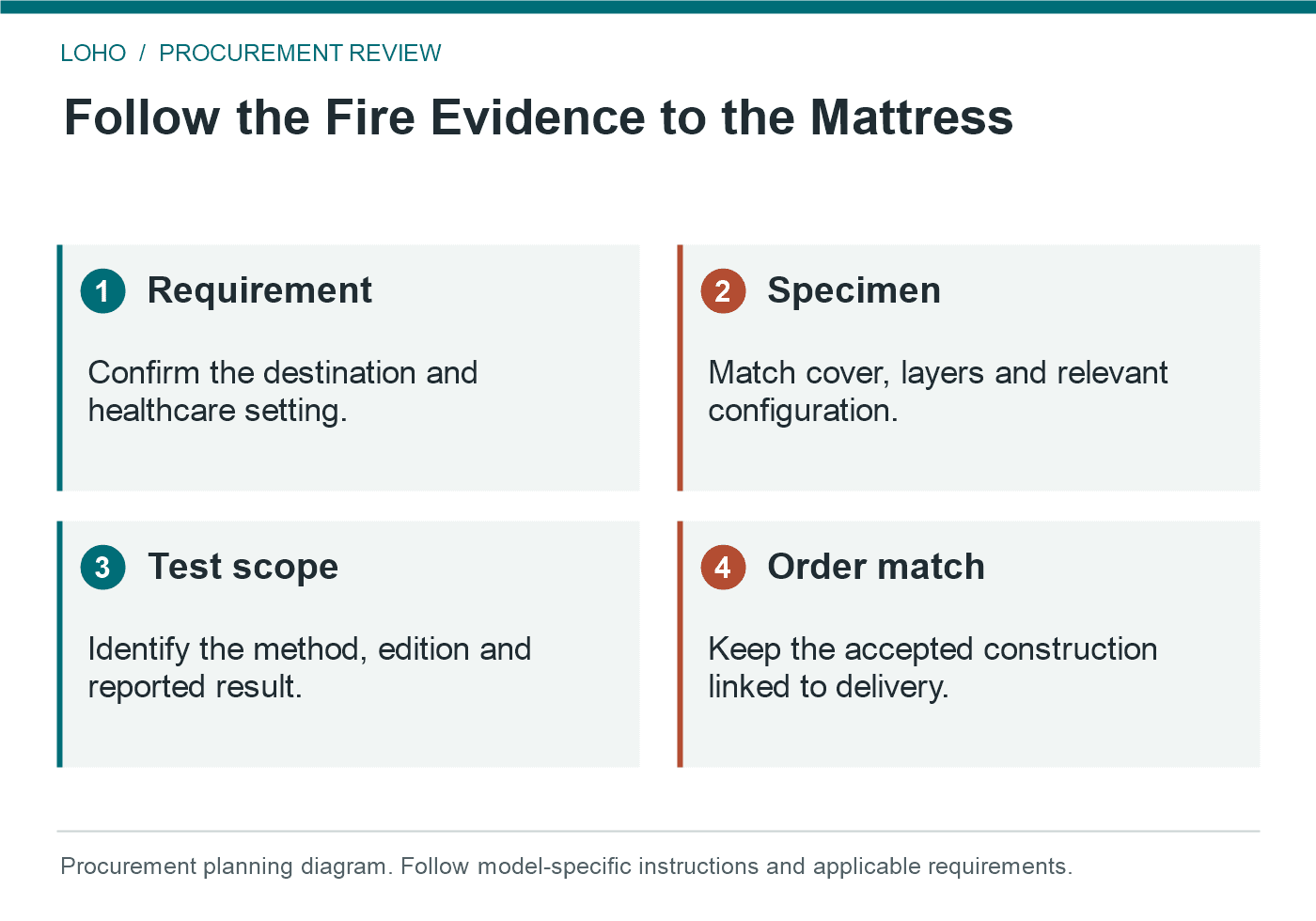
Hospital mattress fire documentation is useful only when it identifies the mattress construction being purchased and the test or regulatory requirement being assessed. A fabric certificate, a general statement about flame resistance, and a test report for a finished mattress answer different questions. Buyers should establish which evidence their project requires before accepting any of them.
For procurement teams, the challenge is often a mismatch between the tested item and the quoted configuration. A different cover, foam, core, zipper, or manufacturing revision may need technical review. This article explains how to organise that review without assuming that a product name or a material description establishes compliance.
Start With The Destination And Intended Setting
There is no single worldwide fire certificate for every hospital mattress. The destination market, product classification, facility requirements, and intended use influence the evidence needed. Ask the project's responsible fire-safety and regulatory personnel to define the applicable requirements before sending a document request to suppliers.
For healthcare premises in England, the government's fire-safety risk-assessment guidance provides a setting-specific reference. It should not be represented as a universal product approval scheme. A facility's review of its fire risk and a laboratory's assessment of a mattress are connected activities, but they serve different purposes.
Record the agreed test references and editions in the enquiry. If the specification says only "fireproof mattress," ask for clarification. An absolute phrase cannot define the ignition source, test specimen, performance criteria, or evidence needed for an acceptance decision. It also invites suppliers to respond with documents that cannot be compared meaningfully.
Identify The Complete Mattress Construction
Request a controlled description of the offered mattress: core materials, layer arrangement, cover, closures, seams, dimensions, and any relevant accessories. The purpose is to connect the product with its evidence, not to demand disclosure of every confidential manufacturing detail. A supplier can provide a suitable configuration reference and explain how the report maps to it.
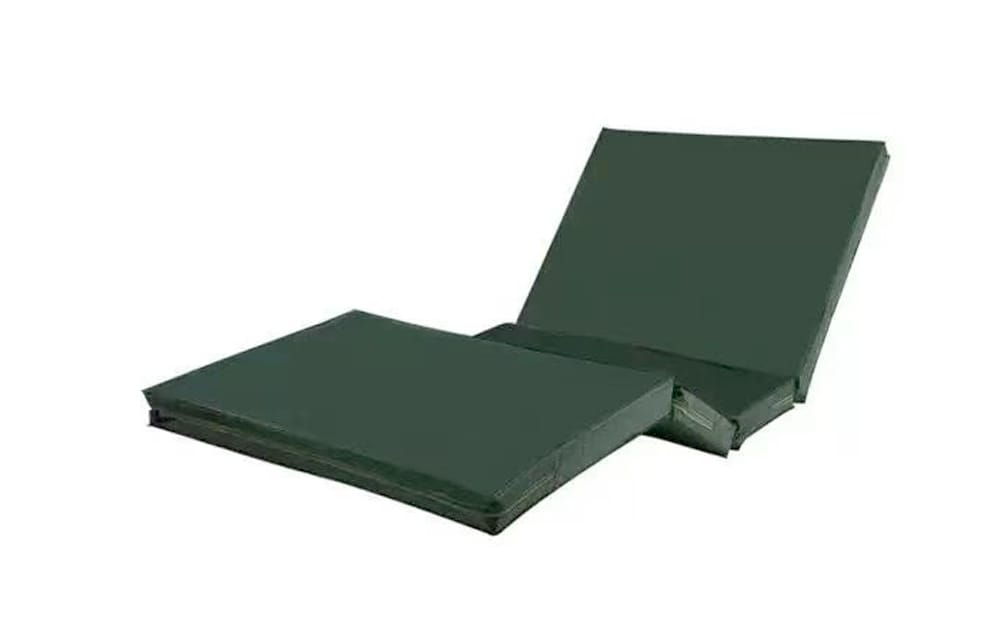
LOHO's coconut coir hospital bed mattress is described as combining a 4 cm coir layer with a 2 cm sponge layer and a removable waterproof canvas cover. That description establishes the published construction. It does not, by itself, establish performance under any particular ignition test.
For this or another mattress, ask the supplier to identify the exact configuration covered by the available report. Do not substitute evidence for a visually similar mattress or assume that a different cover colour has no technical implications. Changes should be assessed by the responsible manufacturer and reviewer against the evidence, not decided from appearance.
Separate Fabric Evidence From Assembly Evidence
A cover-material report may be relevant to that material, but it may not describe the behaviour of the complete mattress. Likewise, a report covering a particular core-and-cover assembly may not support another combination. Read the specimen description before focusing on the result page.
| Document offered | What it may establish | What still needs checking |
|---|---|---|
| Cover-material report | Results for the identified fabric specimen and test | Whether that evidence meets the project's mattress requirement |
| Finished-mattress report | Results for the tested assembly | Match to the offered layers, cover, dimensions, and revision |
| Supplier declaration | Manufacturer's stated conformity and scope | Supporting evidence and applicable requirement |
| Product label | Identification and specified marking information | Consistency with the declaration, report, and delivered item |
| General quality certificate | Scope of a management-system assessment | Product-specific fire-performance evidence |
| Change assessment | Explanation of a revised construction | Technical basis and reviewer acceptance of the change |
Ask the reviewer to record why the evidence is sufficient, insufficient, or requires clarification. A simple "certificate received" checkbox is inadequate when the question is whether that certificate concerns the actual product and requirement. Keep the supplier's answer with the document rather than relying on an unrecorded conversation.
Read The Test Reference And Its Limits
The report should identify the test method, edition, specimen, laboratory, date, results, and any qualifications. Confirm that attachments and referenced pages are present. A cropped pass statement can omit the very information needed to determine applicability.
The NHS publication HTM 05-03 Part C: Textiles and Furnishings discusses fire-safety considerations for healthcare textiles and furnishings. It is a published healthcare reference, not evidence that a particular LOHO mattress has been tested. Ask the responsible project specialist to establish the current specification and any relevant edition or policy requirements.
Do not rewrite a test result into a broader claim. Performance against a defined ignition source does not mean a mattress cannot burn in any fire. Keep the language in the approved purchasing and product records tied to the actual evidence. Marketing descriptions and tender responses should use the same verified scope.
Treat US Requirements As A Separate Review
For a US project, begin with product classification rather than importing the wording from a UK tender. The Consumer Product Safety Commission's mattress flammability guidance distinguishes the smouldering requirements in 16 CFR Part 1632 from the open-flame requirements in Part 1633. It also describes a narrow medical-device exemption that must not be assumed merely because a mattress is sold for healthcare use.
Have the qualified reviewer determine the applicable route and evidence for the exact product. Do not conclude that every hospital mattress is exempt, or that a report to one country's standard automatically answers another country's requirement. A product description containing the word medical is not a classification decision.
The same discipline applies to other destinations. Name the market, ask for the relevant documented basis, and record who has reviewed it. This allows the manufacturer and importer to discuss the actual requirement instead of exchanging unrelated certificates until a familiar logo appears.
Control Changes To Covers And Replacement Parts
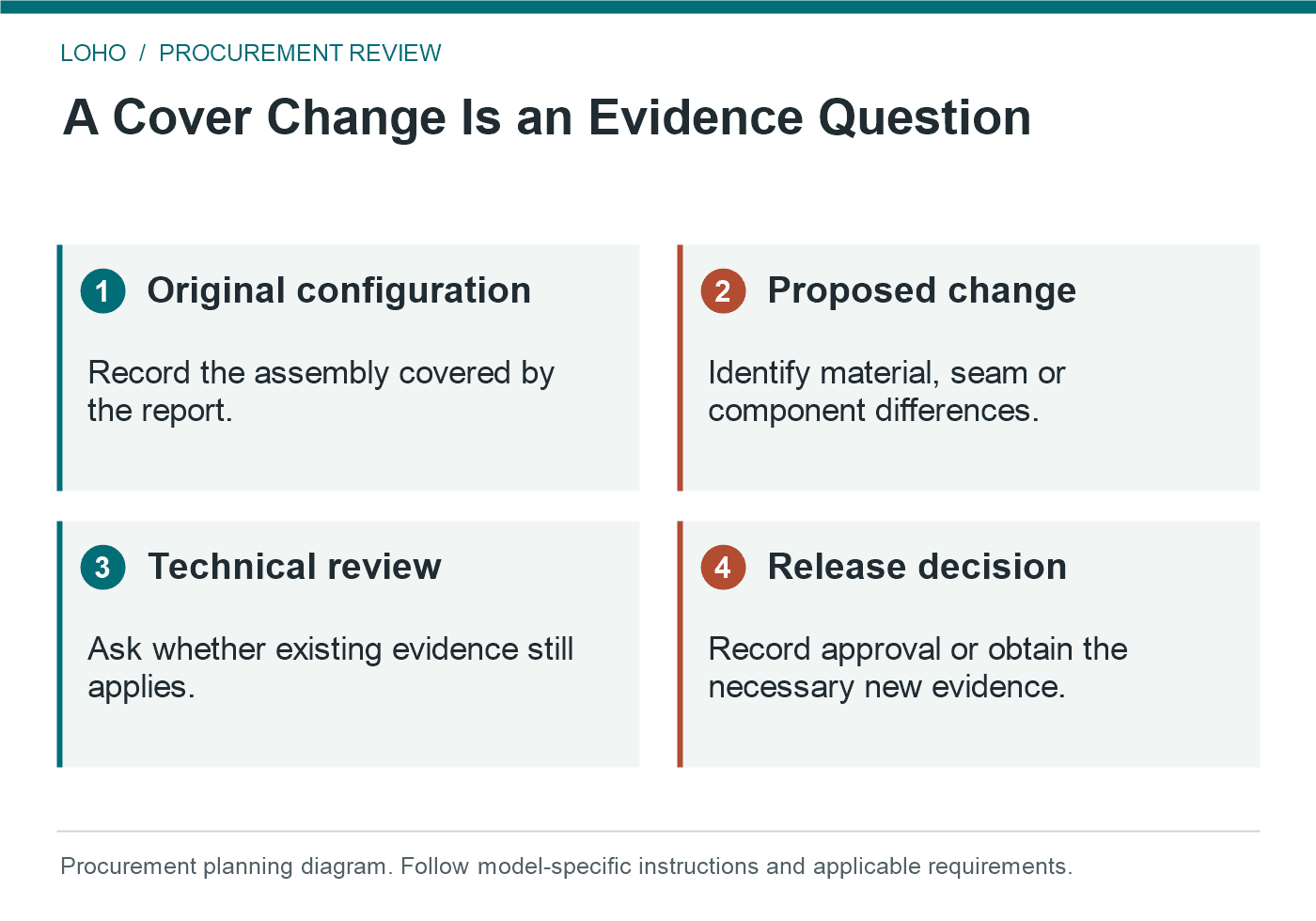
The evidence review should continue after the first order. Replacing a cover can change the construction that was originally assessed. Ask which replacement references are approved and what restrictions apply to alternatives, repairs, added layers, or other modifications.
Keep the approved cover reference in stores records and service instructions. If the supplier proposes a new material, request a documented change assessment before accepting it as equivalent. A promise that the new cover is more durable or easier to clean does not answer the fire-performance question.
For broader system considerations, use LOHO's hospital bed mattress compatibility guide. Fit and fire documentation must both be reviewed, but a satisfactory result in one area cannot compensate for an unresolved issue in the other. The same replacement may affect dimensions, cleaning, and the construction represented in the report.
Link Documents To Delivered Stock
At receipt, compare the product label and identifying details with the order and approved configuration. Keep the evidence accessible to those managing the equipment, rather than storing it only in a purchasing inbox. Where a batch or serial identifier is available, use it to connect delivered stock with the record.
The MHRA's device-management guidance includes acquisition and lifecycle management. For a mattress project, a practical document register can show the product reference, supplier, construction revision, supporting report, reviewer, and acceptance date. This is a suggested purchasing control, not a claim that one register format satisfies every jurisdiction.
When a delivery differs from the approved description, identify the affected stock and request clarification before releasing it. Avoid relabelling the item locally to match the purchase order. If the change is acceptable, retain the technical basis and the updated identification so later replacements can be matched correctly.
Write A Focused Supplier Request
A useful request names the destination, care setting, mattress configuration, applicable fire requirement, and the documents needed for review. Ask for a report or appropriate evidence with sufficient specimen detail, plus an explanation of how it relates to the offered product. Specify whether translations or complete attachments are required.
Review the relevant LOHO mattress and accessory range before finalising the product reference. If a mattress is supplied with a bed package, confirm that the package contains the same configuration reviewed in the documentation. A bed model number alone may not identify the cover or internal construction.
Discuss unresolved questions through LOHO's service page. Keep requests specific: "Please identify the cover and core represented in this report" is more productive than asking whether the product has all certificates. Do not promise compliance to a downstream customer while important scope questions remain open.
Conclusion
Good documentation connects the required test, the assessed construction, and the delivered mattress. Review those three elements together, retain the acceptance basis, and revisit it when materials or replacement parts change.
Send LOHO your mattress specification and destination requirements to discuss the available product information and supporting documents. The final acceptance should reflect the project's qualified technical review.
FAQ
Does a waterproof cover also demonstrate fire resistance?
No. Resistance to liquid penetration and performance in a fire test are different properties. Request the evidence relevant to each requirement.
Can a fabric test replace a finished-mattress test?
Only if the applicable requirement and qualified reviewer establish that the offered evidence is sufficient. Do not assume the two specimen types are interchangeable.
Should buyers accept an old report automatically?
No. Check the method, construction, document authenticity, and relevance to current requirements. Age alone neither proves invalidity nor establishes continued applicability.
Is a change of mattress supplier acceptable if dimensions match?
Matching dimensions does not establish equivalent materials or fire performance. Review the replacement construction and evidence separately before approval.
What should be retained after the document review?
Keep the complete evidence, the approved configuration, clarification correspondence, and the review decision. Link those records to the delivered product identification where available.