Table of Contents
Overbed table load capacity should be a documented limit for the supplied table, with clear conditions for how the load is positioned. It is not a patient weight rating. Before selecting a table for a ward or care facility, establish its intended use, loading restrictions, adjustment instructions, and compatibility with the bed in the positions staff will actually use.
A tabletop that looks substantial may still have restrictions on concentrated loads, edge loading, or adjustment while loaded. This guide explains what procurement teams should request when a quotation gives dimensions but does not explain the load claim. It does not provide a substitute rating for an untested product.
Start With The Intended Task
A table for meals, reading, and personal items has a different role from equipment designed to support a person during transfers. Specify the activities expected at the bedside and ask the manufacturer to confirm which are permitted. Staff should not have to infer the intended use from the product name.
Consider an illustrative ward in which a patient may try to push down on the nearest surface when standing. That foreseeable behaviour is relevant to the local risk assessment, but it does not convert an overbed table into a transfer aid. Address the behaviour through equipment selection, placement, and the care plan rather than assigning an unofficial capacity to the table.
The HSE's moving and handling equipment guidance concerns selecting equipment for the handling task. Keep the table's function separate from the equipment and assistance specified for patient movement.
Read Dimensions Separately From Capacity
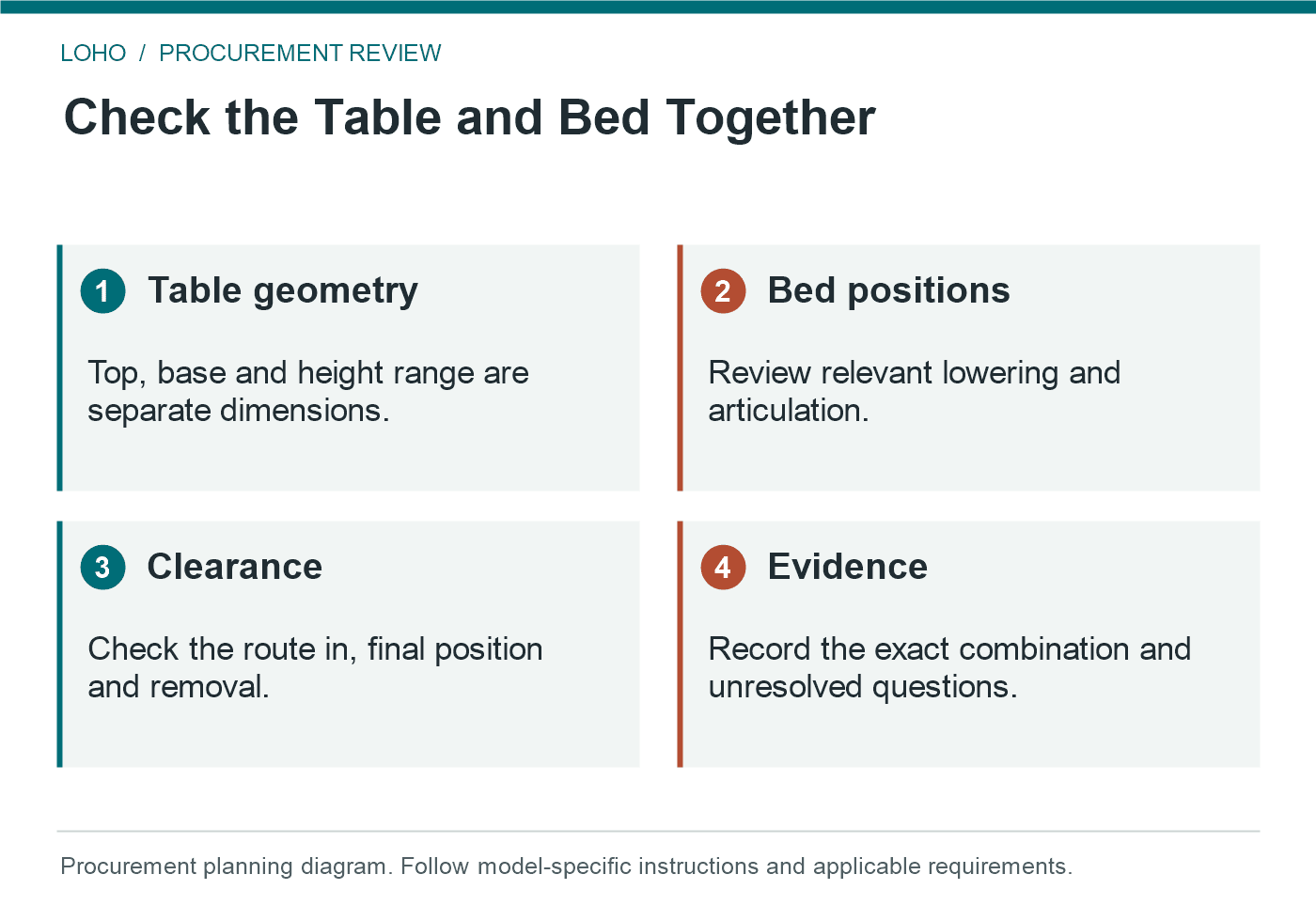
LOHO's adjustable overbed table lists an 800 x 400 mm tabletop, a 750-1050 mm height range, and a 670 x 390 mm base. These dimensions help a buyer review reach and bed clearance. They do not establish a numerical load rating, which is not stated on the public page.
Request that rating in writing for the exact configuration being quoted. Ask whether the stated limit covers a distributed load, a concentrated load, or another defined condition. The response should also describe any restrictions related to the height setting, tabletop position, and moving or adjusting the table.
A useful quotation keeps dimensional information and performance evidence in separate fields. This prevents a drawing of the table from being treated as proof of strength. It also gives the technical reviewer a clear list of information still outstanding before sample approval.
Ask Where The Load May Be Placed
The same total mass can act differently when spread across the surface or concentrated near an edge. For procurement purposes, ask the supplier to explain the permitted arrangement instead of assuming that every point on the tabletop has the same allowable use. Include normal bedside items and any proposed equipment in the discussion.
If the intended task involves a monitor, pump, or another device, provide its dimensions and mounting or restraint requirements as well as its mass. A simple combined weight calculation does not resolve stability, cable routing, or whether the table is intended to carry that equipment. Obtain agreement from the responsible clinical or engineering team where necessary.
Do not conduct an improvised overload demonstration to fill an evidence gap. A sample that survives a short demonstration has not thereby acquired a validated working limit. The manufacturer should provide the applicable assessment and instructions, with competent technical review where the purchase requires it.

Examine Height Adjustment Under Real Conditions
Ask whether the surface must be unloaded before height adjustment and how the locking mechanism should be checked afterward. The answer should come from the specific table instructions. An apparently convenient control may behave differently from a similar-looking mechanism used elsewhere in the facility.
During the agreed sample evaluation, have staff follow the permitted procedure with the table positioned beside the intended bed. Observe reach to the control, hand clearance, and whether the setting is easy to confirm. Record the height used and the activity being assessed so that the evaluation is repeatable.
The FDA's human factors guidance for medical devices considers the relationship between users, environments, and tasks. That is a useful review approach here, not a claim that a local table trial constitutes formal regulatory usability validation.
Check The Base Throughout Bed Movement
A base that fits beneath an empty, raised bed may encounter obstructions when the bed is lowered or articulated. Review the combination with the actual bed frame, floor-level components, and any adjacent equipment. Include the path used to move the table into and out of position, not just its final location.
LOHO describes brake casters on the listed table. Ask which wheels brake, how the brakes are operated, and what the instructions require before use. Wheel brakes should not be interpreted as permission to lean on the tabletop or use it for patient support.
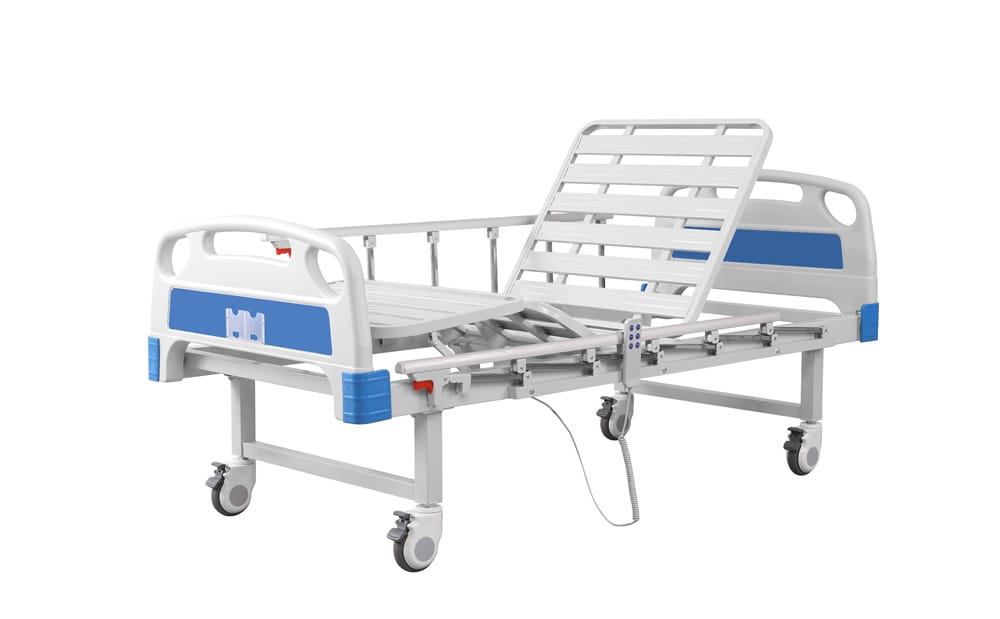
Compare the table with the planned models in the electric hospital bed range. A category match alone does not confirm clearance. Keep a record of the specific bed-and-table combination evaluated, especially when future orders may substitute a different base or frame.
Use A Load-Evidence Review Table
| Question | Evidence to request | Reason it matters |
|---|---|---|
| What is the intended use? | Model-specific instructions and restrictions | Separates bedside activities from patient support |
| What capacity is declared? | Written rating with units and configuration | Prevents inference from appearance or dimensions |
| How is the load positioned? | Distributed and concentrated loading conditions | Clarifies whether the proposed task is covered |
| Can height be changed while loaded? | Operating sequence and warnings | Avoids an assumed adjustment procedure |
| What supports the claim? | Applicable test or assessment with sample identity | Connects evidence to the quoted table |
| Does it fit the bed? | Recorded clearance review at relevant positions | Identifies interference before deployment |
| What happens after damage? | Withdrawal, inspection, and repair instructions | Prevents continued use based on an old rating |
Use the table to compare the completeness of supplier responses, not to award a score simply for sending more documents. A concise report that identifies the correct model and test conditions can be more useful than a large file of unrelated certificates.
Where a response is unclear, quote the exact statement back to the supplier and ask for its meaning. For example, a bare number without units or loading conditions should remain an unresolved item rather than becoming a purchasing assumption.
Include Cleaning And Surface Condition
The table is also a frequently handled bedside surface. Ask for cleaning instructions covering the top, edges, support, controls, and wheels. Confirm compatibility with the facility's procedure, including drying and any restrictions around the adjustment mechanism. Material descriptions alone do not identify every acceptable disinfectant.
The CDC's environmental services recommendations address cleaning in healthcare settings. The practical purchasing question is whether the table can be maintained using the facility's approved process without conflicting with the manufacturer instructions. Resolve that question with the relevant teams before routine use.
Inspect the sample for accessible surfaces and for areas where damage would be difficult to identify. Do not describe a table as suitable for repeated chemical exposure unless the supplied instructions support that use. Cleaning compatibility and load capacity are separate acceptance items; neither substitutes for the other.
Make Handover Instructions Specific
A short handover sheet should identify the table, its permitted tasks, the manufacturer's load conditions, the adjustment sequence, and the defect-reporting route. Avoid translating a technical rating into a simpler but different statement such as suitable for anything below a certain weight. Preserve the conditions attached to the rating.
HSE work-equipment inspection guidance supports a risk-based approach to checks. Determine local inspection arrangements from the equipment instructions and actual use. A table subject to a reported impact or unusual loading may need review outside its routine schedule.
Discuss component identification and support through LOHO's service page. Replacement casters, tops, or adjustment parts should be confirmed for the model rather than selected because they appear to fit. Keep the repaired configuration connected to the original documentation.
Conclusion
A defensible overbed-table decision needs more than a capacity number. Match the intended task to the manufacturer's loading conditions, then check adjustment, clearance, cleaning, and handover in the actual bedside arrangement.
Send LOHO the intended use, bed model, and required load evidence when requesting a quotation. Treat any missing numerical rating as a question to resolve, not a specification to estimate.
FAQ
Is tabletop size a reliable guide to load capacity?
No. Dimensions describe available space, not verified strength or stability. Request the model-specific capacity and the conditions attached to it.
Can an overbed table be used to help a patient stand?
Do not assume so. Use equipment and assistance appropriate to the assessed transfer task. A bedside-table load rating is not a patient-support rating.
Does locking the casters increase the permitted load?
Not unless the manufacturer explicitly defines a different permitted condition. Braking instructions and loading restrictions must be read together without inventing a new limit.
Should buyers test a sample beyond its stated capacity?
Not as an informal purchasing demonstration. Agree any required testing with qualified personnel using appropriate methods, and keep routine user evaluation within the instructions.
What should be recorded if a table is damaged?
Identify the model and affected part, describe the event if known, and follow the local withdrawal and reporting procedure. Obtain a competent assessment before returning suspect equipment to use.