Choosing between an electric hospital bed and a manual hospital bed is not simply a matter of selecting the model with more functions. For hospitals, nursing homes, rehabilitation centers, distributors, and healthcare project buyers, the right choice depends on patient needs, caregiver workflow, budget, maintenance capacity, and how frequently the bed needs to be adjusted.
An electric hospital bed can make frequent positioning easier and reduce the physical effort required for routine adjustments. A manual hospital bed, by comparison, may provide simpler operation, lower initial investment, and easier maintenance in healthcare environments where powered adjustment is not essential.
This guide compares electric hospital bed vs manual hospital bed options from a practical procurement perspective, helping professional buyers choose a suitable configuration for different healthcare environments.
Table of Contents
What Is an Electric Hospital Bed?
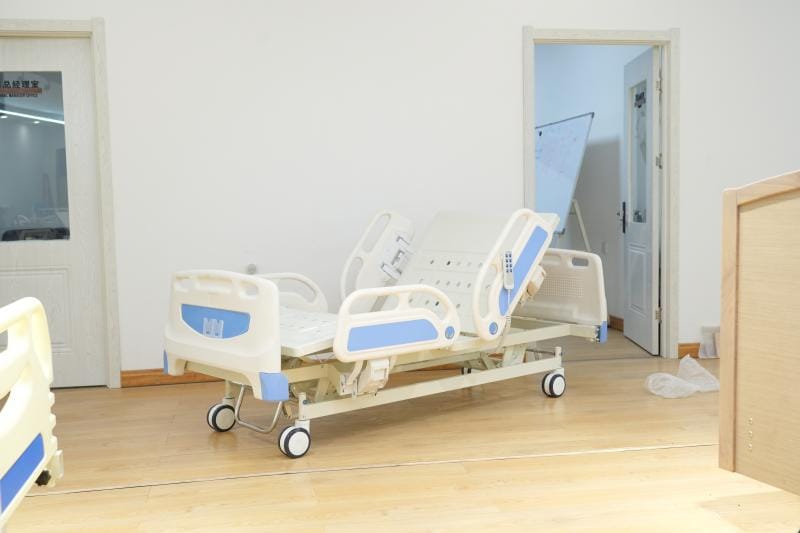
An electric hospital bed uses electric actuators or motors to adjust one or more sections of the bed. Depending on the model, users or caregivers may control the backrest, leg section, bed height, or other positioning functions through a handset or control panel.
Electric beds are commonly considered for hospitals, nursing facilities, rehabilitation environments, and other settings where patients may require frequent repositioning.
A typical 3-function electric hospital bed may provide multiple powered adjustments that help caregivers manage patient positioning more efficiently.
Common Electric Hospital Bed Functions
Depending on the specific model, functions may include:
- Backrest adjustment
- Leg or knee section adjustment
- Height adjustment
- Combined position adjustment
- Central braking systems on selected models
- Optional advanced positioning functions
The exact configuration varies between models. Buyers should therefore compare actual specifications rather than assuming that every electric hospital bed provides the same functions.
What Is a Manual Hospital Bed?
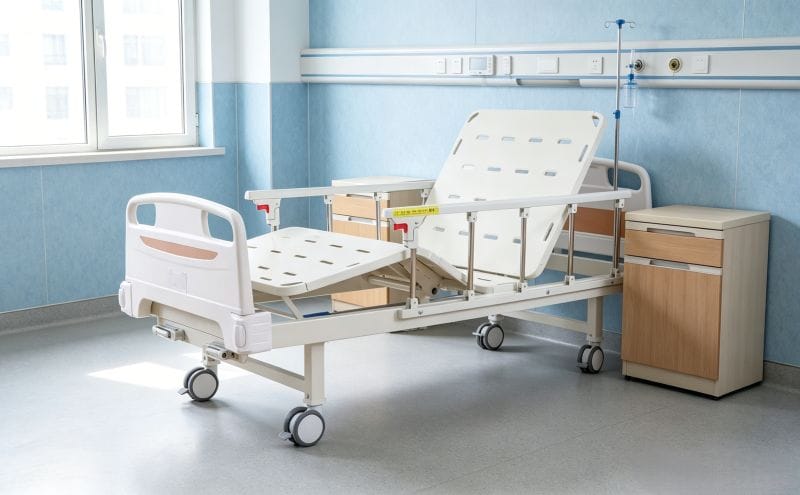
A manual hospital bed uses hand cranks or another mechanical system to adjust the bed platform.
Depending on the configuration, a manual model may provide one, two, or several adjustment functions. Common options include adjustable backrests and leg sections.
Because basic adjustment does not depend on electric motors, manual hospital beds can be suitable for facilities that require dependable positioning with relatively simple operation and maintenance.
For large healthcare procurement projects, buyers should compare the care environment and required functions before choosing a bed type. LOHO’s guide on how to choose a hospital bed manufacturer in China also explains why supplier capability, technical documentation, quality control, and after-sales support should be evaluated before bulk purchasing.
Electric Hospital Bed vs Manual Hospital Bed: Key Differences
The main difference between electric and manual hospital beds is how adjustments are performed. However, this difference also affects caregiver workload, patient independence, maintenance, project costs, and daily workflow.
| Comparison Factor | Electric Hospital Bed | Manual Hospital Bed |
|---|---|---|
| Adjustment Method | Electric motor and control system | Hand crank or mechanical adjustment |
| Ease of Positioning | High | Moderate |
| Patient Independence | Higher on suitable models | Usually lower |
| Caregiver Effort | Lower for frequent adjustments | Higher for repeated adjustment |
| Initial Purchase Cost | Generally higher | Generally lower |
| Maintenance Complexity | More electrical components | Simpler mechanical structure |
| Power Requirement | Usually required | Not required for basic operation |
| Typical Application | Frequent positioning and higher care demands | Basic care and budget-sensitive projects |
Neither option is automatically better for every facility. The correct choice depends on how the bed will actually be used.
1. Adjustment and Daily Operation
One of the most important differences in the electric hospital bed vs manual hospital bed comparison is adjustment efficiency.
Electric Hospital Beds
Electric controls allow different sections of the bed to be repositioned with relatively little physical effort. This can be particularly useful when:
- Patients require frequent position changes
- Caregivers manage multiple beds
- Bed height must be adjusted during daily care
- Suitable patients need greater control over their own positioning
For facilities with frequent care activities, powered adjustment may support a more efficient workflow.
Manual Hospital Beds
Manual beds require an operator to use a crank or mechanical adjustment system. For occasional adjustments, this may be completely adequate.
However, when positions must be changed repeatedly throughout the day, manual operation can increase physical workload.
The World Health Organization notes that lifting, transferring, repositioning, and moving patients without appropriate techniques or handling equipment can contribute to musculoskeletal injury among healthcare workers. For this reason, equipment selection should also consider the physical demands placed on caregivers.
Learn more about unsafe patient handling from the World Health Organization.
2. Patient Independence
Electric hospital beds may provide an advantage when patients are physically and cognitively able to use controls safely.
A patient may be able to adjust the backrest or leg position without waiting for a caregiver. This can be useful in some long-term care and rehabilitation environments where comfort positions change frequently.
Manual hospital beds usually depend more heavily on caregiver assistance because adjustment mechanisms are generally located on the bed frame.
However, greater patient control is not necessary in every healthcare setting. For patients who require continuous assistance, the difference in independent operation may be less important.
3. Caregiver Workload
Healthcare procurement decisions should consider not only the patient but also the daily working conditions of caregivers.
Repeatedly adjusting a manual bed can require more physical effort, especially when a facility has many beds or patients need frequent repositioning.
Electric adjustment can simplify routine positioning tasks. Depending on the model, caregivers may adjust bed sections or working height without repeatedly operating manual cranks.
The key procurement question is:
How often will staff need to adjust the bed during a normal day?
A low-frequency care environment may operate efficiently with manual beds, while a high-frequency environment may benefit more from powered adjustment.
4. Purchase Cost and Project Budget
Manual hospital beds generally have a lower initial purchase cost because their mechanical structure is simpler and they do not require the same motor and control systems as electric models.
This can make manual beds attractive for:
- Large-volume healthcare projects
- Budget-sensitive procurement
- General wards
- Temporary medical facilities
- Markets where simple maintenance is a priority
Electric hospital beds usually require a higher initial investment. However, buyers should avoid making a decision based only on unit price.
For a large project, the total procurement calculation may also include:
- Required bed functions
- Expected service life
- Maintenance requirements
- Replacement parts
- Staff workflow
- Mattresses and accessories
- Transportation
- Installation
- After-sales support
LOHO’s medical bed distributor guide provides additional guidance for distributors planning a practical product range around different customer needs and care environments.
5. Maintenance Requirements
Maintenance is another important consideration when comparing electric and manual hospital beds.
Electric Hospital Bed Maintenance
Electric models may include:
- Motors
- Actuators
- Hand controls
- Wiring
- Control boxes
- Power components
These components should be inspected and maintained according to the product configuration and supplier guidance.
For large procurement projects, buyers should discuss spare parts availability and after-sales support before placing an order.
Manual Hospital Bed Maintenance
Manual beds usually have fewer electrical components and may be easier to maintain in facilities with limited technical support.
Maintenance may focus more on:
- Crank mechanisms
- Moving joints
- Castors
- Brakes
- Side rails
- Fasteners
This simpler structure can be an advantage in markets where specialist electrical maintenance or replacement components may be difficult to access.
6. Power Supply and Facility Conditions
An electric hospital bed normally depends on a suitable power supply for powered adjustment.
This should be considered when beds are purchased for:
- Remote healthcare facilities
- Temporary medical projects
- Areas with unstable electricity
- Emergency care environments
- Facilities with limited infrastructure
Manual hospital beds can continue to provide mechanical adjustment without electrical power.
For modern hospitals and established nursing facilities, power availability may not be a major concern. For infrastructure-sensitive projects, however, it can significantly affect product selection.
7. Which Bed Is Better for Hospitals?
Hospitals usually contain several departments with different requirements. Therefore, using one bed configuration for every area may not be the most efficient procurement strategy.
Electric hospital beds may be more suitable where:
- Patients require frequent positioning
- Staff need efficient height adjustment
- Caregiver workloads are high
- More flexible adjustment functions are required
Manual beds may be appropriate for:
- General wards with basic positioning needs
- Temporary facilities
- Budget-controlled projects
- Areas where simpler operation is preferred
The best hospital procurement plan may include several bed types rather than a single model across all departments.
The World Health Organization emphasizes the broader importance of reducing avoidable harm and improving safety and quality across healthcare settings. Equipment selection is only one part of this larger patient-safety framework.
Read the WHO Global Patient Safety Action Plan.
8. Which Bed Is Better for Nursing Homes?
Nursing homes and long-term care facilities often have different priorities from acute-care hospitals.
Residents may remain in the same bed for longer periods and may require regular assistance with positioning, transfers, and daily care.
Electric beds can be useful when frequent adjustments are required. They may also allow suitable users to control certain positions independently.
Manual beds can still be practical for residents with relatively simple care requirements or for facilities operating under stricter procurement budgets.
When choosing beds for a nursing home, buyers should evaluate several factors.
Resident Mobility
Can the resident reposition independently, or is caregiver assistance always required?
Adjustment Frequency
Will the bed position change several times each day or only occasionally?
Staffing Conditions
Would electric adjustment meaningfully reduce repetitive manual tasks?
Maintenance Capacity
Can the facility support the electrical and mechanical maintenance requirements of the selected model?
Rehabilitation needs may also influence equipment selection. The World Health Organization defines rehabilitation as interventions designed to optimize functioning and reduce disability for people with health conditions.
Learn more about rehabilitation from WHO.

How to Choose Between an Electric and Manual Hospital Bed
Before requesting a quotation, professional buyers should define the actual application.
Step 1: Identify the Care Environment
Determine whether the beds will be used in:
- Hospitals
- Nursing homes
- Rehabilitation centers
- Clinics
- Home care projects
- Healthcare distribution channels
Different environments may require different levels of adjustment.
Step 2: Define Required Functions
Do not purchase functions simply because they are available.
Instead, determine which adjustments are genuinely required for the target users and daily care process.
For buyers comparing different function levels, LOHO’s guide to 2-function vs 3-function vs 5-function hospital beds can help clarify how bed configurations differ.
Step 3: Calculate the Required Quantity
A small order and a large hospital project may require different procurement strategies.
For larger projects, standardizing key configurations can simplify:
- Staff training
- Spare parts management
- Maintenance
- Future replacement orders
Step 4: Review Accessories
The bed itself is only one part of the complete care environment.
Depending on the project, buyers may also need:
- Mattresses
- IV poles
- Overbed tables
- Bedside cabinets
- Dining boards
- Side rail configurations
- Spare parts
Confirming accessories before ordering can reduce compatibility problems later.
Planning should also include transportation, room access, assembly, and final handover. LOHO’s guide to hospital bed delivery and installation explains several practical factors buyers should confirm before equipment arrives.
Step 5: Discuss Customization and Supplier Support
For distributors and project buyers, product specifications may need to match local market requirements.
Before placing a bulk order, discuss:
- Bed dimensions
- Required functions
- Accessories
- Packaging
- Voltage requirements for electric models
- Spare parts
- Documentation
- Branding requirements
- Delivery arrangements
A clear specification process helps reduce misunderstandings during production and delivery.
Can Electric and Manual Hospital Beds Be Used in the Same Project?
Yes. In many healthcare projects, a mixed procurement strategy can be more practical than selecting only one type of bed.
For example, a facility may use:
- Electric beds in departments requiring frequent adjustment
- Manual beds in general care areas
- Nursing beds for long-term care environments
- Specialized configurations for different patient groups
This approach allows procurement teams to match the equipment investment more closely with actual care requirements.
Common Procurement Mistakes to Avoid
Choosing Only by Price
A lower purchase price does not necessarily mean a lower total project cost. Maintenance, spare parts, accessories, delivery, and workflow should also be considered.
Buying More Functions Than Necessary
A more complex bed is not automatically the better option. Unused functions increase cost without necessarily improving the intended application.
Ignoring After-Sales Support
For international buyers and distributors, access to documentation, spare parts, and technical support should be discussed before the first order.
Treating Every Department the Same
Different wards and care environments may require different bed configurations.
Failing to Confirm Delivery Requirements
Packaging dimensions, room access, assembly requirements, and accessory delivery should be confirmed before shipment. More details are available in LOHO’s hospital bed delivery and installation guide.
FAQ
Is an electric hospital bed always better than a manual hospital bed?
No. Electric beds provide easier powered adjustment, but manual beds may be more suitable where basic functions, lower initial costs, simpler maintenance, or independence from electrical power are priorities.
Are manual hospital beds suitable for long-term care?
They can be, depending on the resident’s condition and the frequency of adjustment. Facilities should evaluate caregiver workload and daily positioning requirements before choosing.
Do electric hospital beds require more maintenance?
Electric beds contain additional electrical components such as motors and control systems, so maintenance requirements can be more complex than those of a basic manual bed.
Which hospital bed is more suitable for bulk procurement?
Both types can be suitable for bulk orders. The decision should be based on care requirements, project budget, facility infrastructure, maintenance capacity, and required functions.
Should a distributor stock both electric and manual hospital beds?
In many markets, offering both categories can help serve different customer groups, from budget-sensitive projects to facilities requiring more advanced positioning functions.
Final Decision: Electric Hospital Bed or Manual Hospital Bed?
The electric hospital bed vs manual hospital bed decision should begin with the actual care environment rather than product price alone.
Choose an electric hospital bed when frequent adjustment, easier positioning, and reduced manual operation are important priorities.
Choose a manual hospital bed when basic adjustment, simple maintenance, power independence, and cost control are more important.
For hospitals, nursing homes, distributors, and healthcare project buyers, the most effective approach is to define the required functions first and then compare suitable configurations.
LOHO Medical provides hospital beds and related healthcare equipment for different care environments and procurement requirements. Buyers can also review the company’s hospital bed manufacturer selection guide before evaluating a long-term supplier.
For bulk orders, distributor cooperation, OEM requirements, or healthcare project sourcing, contact LOHO Medical to discuss the required functions, quantities, accessories, customization, and delivery requirements.